What's in this note
- What an ice dam actually is
- What a standard policy usually covers
- Where the money actually goes
- The exclusion that decides most claims
- Roof age, and why it changes the answer
- What to do when it happens
- Deciding whether to claim at all
- Preventing them, which also protects coverage
- A worked example
- What the adjuster is actually assessing
- Contents, additional living expenses, and what else the policy may cover
- Common reasons these claims fail
- Reading your own policy before winter
- Why ice dams form on some houses and not others
- Removal: what to pay for and what to refuse
- Renters, condos and landlords
- After the repair: what to keep and check
- Questions worth asking your insurer before winter
- A worked example where the claim goes badly
- The bottom line
Short answer: Ice dam roof damage is usually covered when the claim is characterised as sudden and accidental water damage: the resulting interior water damage is normally paid, and many policies also name weight of ice, snow, or sleet as a covered peril for structural damage. The ice removal itself often is not covered, the maintenance and neglect exclusion decides most ice dam claims, and older roofs are frequently settled at depreciated actual cash value.
An ice dam is one of the few winter losses where the damage appears indoors while the cause sits on the roof, and where the answer to whether insurance pays depends less on the water than on how the claim is characterised. Sudden and accidental water damage is usually covered. Damage from a condition allowed to persist is usually not.
This walkthrough covers what an ice dam actually is, which parts of the resulting loss a standard policy typically pays for, where the maintenance exclusion bites, and how to document a claim so the distinction falls your way. Every figure below is illustrative; your own policy documents govern.
Key takeaways
- Resulting water damage inside the home is usually covered; the ice removal itself often is not.
- Many policies also name weight of ice, snow or sleet as a covered peril for structural damage.
- The maintenance and neglect exclusion is where most ice dam claims are actually decided.
- Roof age matters: older roofs are frequently settled on actual cash value, so depreciation is deducted.
- Photograph before you touch anything, and record when the weather happened and when you first saw water.
What an ice dam actually is
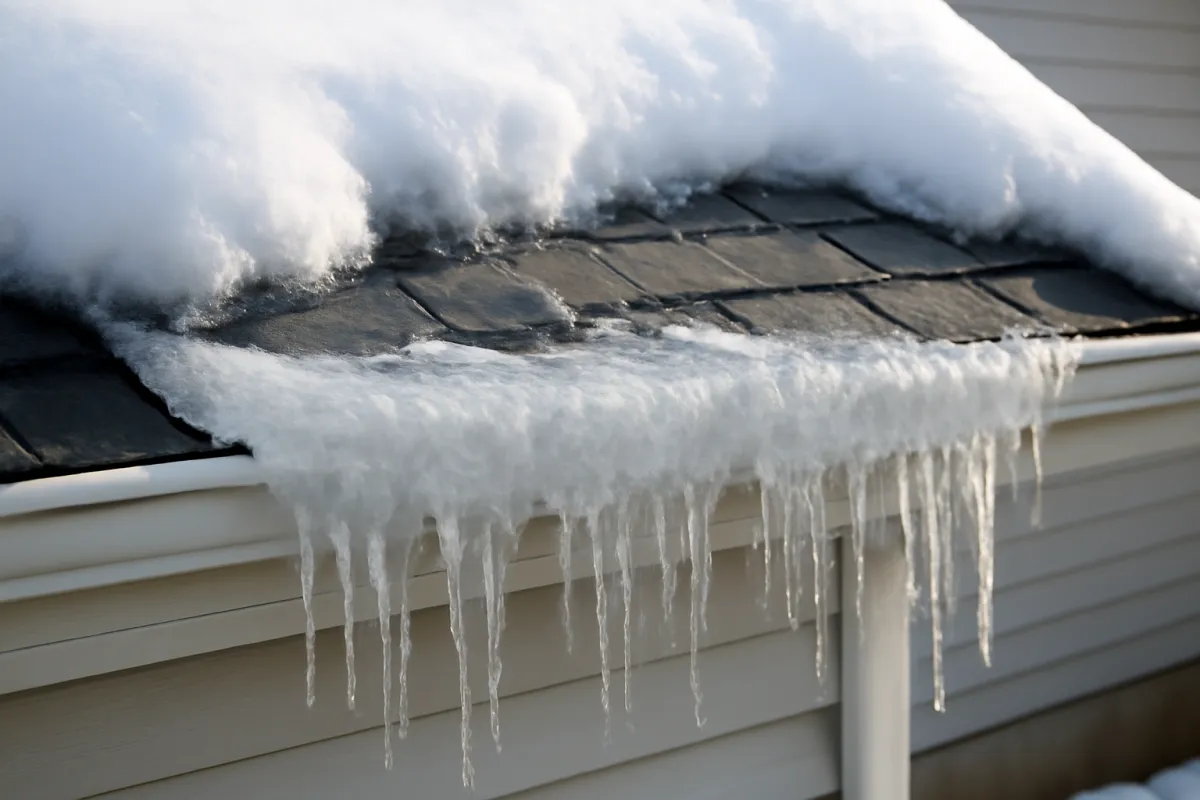
An ice dam is a ridge of ice at the roof edge that stops melting snow from draining away.
The mechanism is heat loss. Warm air escaping from the living space into the attic warms the roof deck, and snow on that warmed section melts. The meltwater runs down toward the eave, which sits over unheated space and stays below freezing, and refreezes there. Repeat over a few cold days and the ridge grows.
Behind that ridge, water pools. This is the part that causes damage, because a shingle roof is engineered to shed water running downhill, not to hold standing water. Given a pool sitting against them, shingles let water travel under and behind, into the roof deck, then the attic, then the insulation, then the ceilings and walls below.
Two consequences follow that shape the insurance question. First, the leak often appears well inside the house, sometimes at a distance from where the water entered, which makes cause harder to establish without documentation. Second, the underlying driver is heat loss rather than a roof defect, which is why the prevention conversation is about insulation and ventilation.
What a standard policy usually covers
Most homeowners policies address ice dams through two routes, and it helps to know which one your loss travels.
Sudden and accidental water damage. This is the main route. When water backs up under shingles and enters the home, the resulting damage to ceilings, walls, insulation, flooring and contents is generally covered, subject to your deductible. The operative words are sudden and accidental, and they are what the maintenance exclusion is measured against.
Weight of ice, snow or sleet. Many policies name this as a covered peril in its own right, addressing structural damage caused by the load itself rather than by water. Collapsed gutters, damaged eaves, and in severe cases structural deflection can fall here.
What generally falls outside both: removing the ice as a maintenance task, repairing a roof that failed because it was worn out, and damage that developed gradually rather than arriving as an event.
Our overview of what home insurance covers sets out the general structure, and does home insurance cover water damage covers the water side across causes.
Where the money actually goes
Illustrative cost split of an ice dam loss
Illustrative allocation for a moderate loss with interior water intrusion. Actual proportions vary widely with how far water travelled.
The interior share is why these claims escalate quickly. Water that enters at the eave can travel along joists and appear several rooms away, and insulation that has been wetted generally has to be replaced rather than dried.
Illustrative repair costs by scope
Illustrative mid-range figures to show relative scale. Regional labour rates and roof access change these substantially.
The bottom bar is the one worth acting on quickly. Removal costs a fraction of what interior damage costs, and stopping active water entry is also what your policy's duty to mitigate expects of you.
The exclusion that decides most claims
Nearly every contested ice dam claim turns on the same question: was this sudden, or was it the predictable result of a condition left unaddressed?
Policies exclude wear and tear, deterioration, and damage from neglect. An insurer applying that exclusion will typically point to evidence such as pre-existing ceiling staining suggesting previous leaks, shingles at or past their expected service life, visible prior repairs, or an attic showing long-term moisture.
The homeowner’s counter is usually the event: a specific weather sequence, water appearing for the first time, and a contractor’s written opinion that the intrusion was caused by ice damming during that event rather than by roof condition.
This is why documentation carries disproportionate weight in this category. A photograph of the eave taken while the ice is still there, and a dated note of when water first appeared, do more to establish suddenness than any amount of subsequent argument.
Roof age, and why it changes the answer
The roof covering itself is assessed differently from the interior damage, and age is the main variable.
If ice or its weight physically damaged sound shingles, that damage can be covered. If the roof was already at or beyond its serviceable life, insurers commonly decline the roof portion on wear-and-tear grounds while still covering the interior water damage, which surprises people who expect one answer for the whole loss.
Settlement basis matters as much as coverage. Many policies settle roofs on actual cash value rather than replacement cost, particularly older roofs, meaning depreciation is deducted from the payment. A roof two thirds through its expected life can therefore produce a settlement well below the cost of replacing it.
Some policies apply a separate, higher deductible to roof claims, or a percentage-of-dwelling deductible rather than a flat amount. It is worth knowing which applies to yours before you need it.
Our notes on roof replacement coverage and actual cash value against replacement cost cover both points in more depth, and leaking roof coverage covers the adjacent case where the cause is the roof itself.
What to do when it happens
Stop further damage, safely. Your policy expects reasonable mitigation. Move contents, put down containers, and if water is actively entering, arrange professional steam removal. Do not go on a roof in winter, and do not chip at ice with tools; both damage the roof and injure people every year.
Photograph before touching anything. The ice at the eave, icicles, the exterior, and every affected interior surface. Wide shots for context, close shots for detail.
Photograph again as it develops. Ceiling staining spreads over days, and the later photographs establish extent.
Note the dates. When the weather event occurred and when you first saw water. That timeline is the backbone of a sudden-and-accidental claim.
Notify your insurer promptly, even if you are still deciding whether to claim. Delay is itself a reason for reduced payment on some policies, and opening a file does not commit you to pursuing it.
Keep damaged materials until the adjuster has inspected them, and keep every invoice for emergency work.
Do not authorise permanent repairs before inspection unless required to prevent further damage, and if you must, photograph everything first.
Our walkthroughs on documenting storm damage and filing a home insurance claim cover the process from here.
Deciding whether to claim at all
Not every ice dam loss is worth filing, and the calculation is worth doing before you call.
Compare the likely repair cost against your deductible. A loss only marginally above it rarely justifies a claim once the effect on future premiums is considered, and water damage is a category insurers watch closely.
Consider your claim history. A single claim on a clean record is treated differently from a third claim in five years, and in some markets frequency affects renewal eligibility rather than just price.
Consider the settlement basis. If your roof would settle on actual cash value and it is well into its life, the payment may be smaller than expected, which changes the arithmetic.
For a large loss with interior damage across multiple rooms, the answer is usually straightforward: claim. Our notes on premium increases after a claim and choosing your deductible cover the trade in detail.
Preventing them, which also protects coverage
Prevention matters twice over: it avoids the damage, and it removes the insurer’s argument that a known condition was left untreated.
Seal air leaks into the attic first. This is the highest-value step and the one most often skipped, because insulation is visible and air sealing is not. Recessed lights, bathroom and kitchen fans, plumbing stacks, wiring penetrations, chimney chases and the attic hatch are the usual culprits. Heat escaping through these is what melts the snow, and adding insulation on top of unsealed penetrations addresses the symptom while leaving the driver in place.
Insulate adequately, and evenly. Insulation keeps heat in the rooms where you want it, which keeps the roof deck cold. Gaps matter more than average depth, because a single uninsulated section creates the warm patch that starts the melt.
Ventilate the roof space. Soffit and ridge ventilation keeps the deck close to outside temperature, so snow melts from sun rather than from below. Blocked soffit vents are extremely common, usually because insulation has been pushed into the eaves at some point, and baffles are the inexpensive fix that keeps the airway open.
Clear gutters before winter. This helps drainage but does not prevent damming on its own, and a blocked gutter makes an existing problem worse. Downspouts matter as much as the gutters themselves, since a clear gutter draining into a blocked downspout still backs up and freezes.
Consider heated cables for a persistent problem area, understanding that they manage the symptom rather than fixing the heat loss. They need to be installed correctly, switched on before ice forms rather than after, and they add running cost through every cold spell, so they suit a specific stubborn valley or dormer better than a whole roofline.
Rake snow off the lower roof after heavy falls, from the ground with a roof rake rather than from a ladder. Clearing the first few feet above the eave removes the snow that would otherwise melt and refreeze at the edge, and it is the one preventive step that works during a winter rather than before it.
If a particular eave dams every winter, that is a documented recurring condition. Addressing it protects the house and removes the strongest argument an insurer can make against a future claim.
A worked example
An illustrative sequence. A cold snap follows heavy snow. Ice builds at the north eave over several days, and on the fourth morning a damp patch appears on a bedroom ceiling.
Day 1. The homeowner photographs the eave from the ground showing the ice ridge and icicles, then the ceiling patch. They put down a container and move furniture. They note the date of the snowfall and the date the patch appeared.
Day 1, later. They call the insurer to notify, and ask specifically whether emergency ice removal falls under mitigation on their policy. They are told reasonable mitigation costs are covered, and they arrange steam removal at roughly $600, keeping the invoice.
Day 3. The ceiling patch has spread. They photograph it again. An adjuster is scheduled.
Day 8. The adjuster inspects. The roof is nine years old and in reasonable condition. The interior damage is accepted as sudden and accidental water damage. A section of underlayment and shingles at the eave is accepted as damaged. Interior repairs are estimated near $4,500, roof repair near $1,800, and the removal invoice is reimbursed.
Settlement. With a $1,000 deductible, the homeowner receives roughly $5,900 against a $6,900 loss, less any depreciation applied to the roof portion depending on the policy’s settlement basis.
Change one variable. Had the roof been twenty-two years old with visible prior staining on the same ceiling, the insurer would likely have accepted less of the roof portion and questioned whether the interior damage was genuinely new, which is precisely the argument that day-one photographs are there to answer.
What the adjuster is actually assessing
Understanding what the adjuster is looking for makes the visit far less opaque, and it is not adversarial in the way people expect.
Cause and suddenness. The central question. They will look at the roof edge, the attic, and the interior damage, and try to establish whether this was a discrete event or an accumulating condition. Attic inspection matters more than most homeowners realise, because long-term moisture leaves marks that a single event does not.
Roof condition and age. Granule loss, curling, prior patch repairs, and the general state of the covering. This drives whether the roof portion is accepted and on what settlement basis.
Extent of water travel. Water entering at an eave can run along framing and appear some distance away, so they will check whether damage in a distant room plausibly connects to the same entry point.
Evidence of prior claims or repairs. Not to catch you out, but because a previously repaired leak in the same location changes the analysis.
Mitigation. Whether reasonable steps were taken once damage was apparent, which affects both coverage and the size of the loss.
Two things help the visit go well. Have your documentation organised and dated rather than scattered across a phone. And be present, because you can point out what was already there before the event, which is information the adjuster otherwise has to infer.
If you disagree with the assessment, ask for the reasoning in writing rather than arguing at the time. A written position is what an appeal or a second opinion works from.
Contents, additional living expenses, and what else the policy may cover
An ice dam loss is rarely confined to the building, and two coverages are commonly overlooked.
Personal property. Furniture, electronics, clothing, stored items in an affected closet or attic, and anything soaked by water coming through a ceiling generally falls under contents coverage rather than dwelling coverage. It carries its own limit and, on many policies, its own settlement basis. Photograph and list damaged items rather than discarding them.
Additional living expenses. If the damage makes part or all of the home uninhabitable, most policies cover reasonable extra costs of living elsewhere: accommodation, and in some cases the difference in meal costs. This is more likely with widespread ceiling damage or where drying equipment makes rooms unusable for a period. Keep receipts.
Debris removal and matching. Some policies address removal of damaged materials, and some address whether undamaged adjacent materials are replaced so finishes match. Matching provisions vary considerably and are worth asking about where visible ceilings or floors are affected in an open-plan space.
Our overview of what home insurance covers sets out how these sit alongside the dwelling coverage, and it is worth asking the adjuster explicitly which apply rather than assuming the claim is only about the building.
Common reasons these claims fail
No documentation of the ice itself. By the time an adjuster attends, the ice has often melted. Photographs taken while it was there are irreplaceable.
Pre-existing stains. Evidence of previous leaks in the same location supports a gradual-damage argument. If prior leaks were repaired, keep those records to show they were addressed.
Repairs made before inspection. Understandable in a cold house, but it removes the evidence.
Delay in notifying. Both a policy breach on many forms and evidence against suddenness.
Mould that developed afterwards. Frequently limited or excluded, and more likely to be attributed to slow response.
A roof past its service life. The single most common reason the roof portion is declined even where interior damage is accepted.
Assuming removal is covered. Check before authorising expensive work rather than presenting an invoice afterwards.
If a claim is denied, that is not necessarily the end. Our walkthrough on appealing a denied claim covers the process, which frequently succeeds where the original problem was evidence rather than merit.
Reading your own policy before winter
Four things are worth establishing while nothing is wrong.
Whether weight of ice, snow and sleet appears as a named covered peril on your form.
Your deductible, and specifically whether a separate or percentage-based deductible applies to roof or weather claims.
Whether your roof is settled on replacement cost or actual cash value, and whether that changes with roof age.
What your policy says about emergency mitigation, and what it expects you to do to limit damage.
These live in the declarations page and the perils and exclusions sections rather than in the summary. Our note on the home insurance declaration page covers how to read it, and what dwelling coverage is covers the structural side.
Why ice dams form on some houses and not others
Two identical-looking houses on the same street can behave completely differently, and the reasons are worth knowing because they point at the fix.
Attic air sealing is the largest single factor. A house with unsealed recessed lights, an uninsulated attic hatch and open plumbing chases loses far more heat into the roof space than one where those are sealed, regardless of how much insulation sits above them.
Insulation depth and coverage. Gaps matter more than average depth. Insulation compressed at the eaves, or missing over a section, creates a warm patch that melts snow while the rest of the roof stays cold.
Ventilation. Soffit vents blocked by insulation are extremely common and defeat the ridge ventilation above them. The roof deck then warms because nothing carries the heat away.
Roof geometry. Complex rooflines with valleys, dormers and low-slope sections trap snow and create more places for water to pool. A simple gable roof sheds snow more readily.
Which direction the roof faces. North-facing slopes stay cold and hold snow, so they dam more often than south-facing slopes that clear in sunshine.
Heat sources below. Bathrooms venting into the attic rather than outside, uninsulated ductwork, and rooms kept warmer than the rest of the house all create local warm spots.
Gutter condition. Blocked or ice-filled gutters do not cause damming on their own but remove the drainage path once melting starts.
If your house dams every winter and your neighbour’s never does, the difference is almost always in the first three items on that list rather than in the roof covering itself. An energy audit that includes a blower-door test and attic inspection identifies which one, and is usually cheaper than a single deductible.
Removal: what to pay for and what to refuse
Once water is entering, removal becomes urgent, and this is the moment homeowners are most likely to be sold something inappropriate.
Steam removal is the appropriate method. Low-pressure steam melts the ice without damaging shingles. It is slower and costs more than the alternatives, which is exactly why the alternatives get offered.
Refuse pressure washing. High-pressure water strips granules from shingles and can drive water further under them, converting a covered water claim into an argument about who caused the roof damage.
Refuse chipping, hammering, axes and shovels on the roof. These crack shingles and gouge the deck. Damage caused during removal is frequently not covered, and it hands the insurer a wear-and-tear argument.
Be cautious with salt products. Calcium chloride in a stocking laid across the dam is a widely used stopgap that can help create a drainage channel. Rock salt corrodes metal flashing, gutters and fixings, and can damage plantings below.
Do not do it yourself from a ladder. Ladders on frozen ground, under falling ice, holding tools, is how people are seriously hurt every winter. This is the single most dangerous part of the whole situation and the part most often underestimated.
Get the invoice itemised and describing the work as emergency mitigation to stop active water intrusion, since that wording matters when you submit it.
Ask the price before work starts. Emergency winter callouts carry a premium and the range is wide, which is another argument for prevention over response.
Renters, condos and landlords
Who insures what changes with how you occupy the building, and ice dams frequently sit exactly on the boundary.
Renters. The building is the landlord’s responsibility, including the roof and the resulting structural damage. A renters policy covers your own belongings damaged by the water and, in many cases, additional living expenses if the unit becomes uninhabitable. Report water entry to the landlord in writing immediately, because a delay that allows damage to worsen can become your problem.
Condo owners. The master policy typically covers the building structure and roof, while your unit policy covers interior finishes, improvements and contents, with the dividing line set by the association’s governing documents. Those documents vary considerably, and the boundary is often described as bare walls, original specification, or all-in. Establishing which applies before a loss is far easier than during one. Deductibles on a master policy can also be substantial and are sometimes passed through to owners. Our note on condo insurance covers the split.
Landlords. A landlord policy covers the structure and typically loss of rental income if the property becomes uninhabitable, while tenants’ possessions are their own concern. Ice dams are a case where documented seasonal maintenance genuinely matters, since a pattern of ignored winter damage invites a neglect argument on a later claim.
In all three cases the practical advice is the same: report promptly in writing, photograph everything, and establish who is responsible for what before winter rather than while water is coming through a ceiling.
After the repair: what to keep and check
The claim is not quite finished when the cheque clears, and a few closing steps prevent the same loss being harder next time.
Keep the complete file. Photographs, the adjuster’s estimate, invoices, the settlement breakdown, and any correspondence. If the same eave leaks in three years, this file is what demonstrates the previous damage was repaired rather than left.
Get repair documentation in writing. A contractor’s description of what was replaced, particularly underlayment or ice-and-water shield at the eave, is evidence that the condition was addressed.
Ask whether ice-and-water membrane was installed. Where a roof section is being repaired anyway, extending a waterproof membrane up from the eave is inexpensive relative to the surrounding work and is the single most effective physical defence against a repeat. Many current codes require it in cold regions on new work.
Check the attic afterwards. Wet insulation loses much of its value and generally needs replacing rather than drying, and insulation that stays compressed and damp is how a one-off becomes annual.
Watch for mould over the following weeks. Report anything that appears promptly, since delay is the usual reason mould coverage is limited.
Reassess your deductible at renewal. Having just experienced a loss, you know concretely what your exposure feels like, which is a better basis for that decision than a hypothetical. Our note on lowering your premium covers the trade-offs.
Book the attic air-sealing work. This is the point at which motivation is highest and the cause is freshest, and it is the step that prevents the whole sequence recurring.
Questions worth asking your insurer before winter
Fifteen minutes on the phone now is worth considerably more than the same call made with water coming through a ceiling.
Is weight of ice, snow and sleet a named covered peril on my form?
Is water damage resulting from ice damming covered, and under which section?
Does a separate or percentage-based deductible apply to roof or weather claims, and what would mine be in dollars?
Is my roof settled at replacement cost or actual cash value, and does that change at a particular age?
What does the policy expect of me by way of emergency mitigation, and are reasonable removal costs reimbursed if water is actively entering?
Is mould resulting from a covered water loss included, and up to what limit?
Does my contents coverage extend to items stored in the attic?
Would additional living expenses apply if ceilings had to be opened and dried?
Ask for the answers by email rather than only over the phone. A written answer is what settles a disagreement later, and the exercise frequently surfaces a gap worth closing at renewal while it is still cheap to do.
A worked example where the claim goes badly
The counterpart to the earlier example, because the failure pattern is as instructive as the success.
A homeowner notices a small brown ring on a bedroom ceiling in January and assumes it is condensation. It fades. The following winter the ring returns larger, and in the third winter, after a heavy snowfall, water runs down the wall.
They call the insurer at that point. The adjuster attends, finds staining at three different ages on the same ceiling, an attic with compressed and previously wetted insulation, and a roof at nineteen years with significant granule loss. The claim for the roof is declined on wear-and-tear grounds, and the interior damage is reduced substantially on the basis that much of it predates the reported event.
Nothing here was unfair. The insurer covers sudden and accidental damage, and the evidence in front of them described a condition running across three winters.
What would have changed the outcome is entirely front-loaded. Photographing and reporting the first ring, even if no claim followed. Having the attic inspected after the first occurrence. Sealing the air leaks that were melting the snow. Any of those would have converted the third-winter event from the latest instalment of a known problem into a discrete loss on a maintained house.
The general lesson holds beyond ice dams: with water, the cheapest moment to act is the first time you see a stain, and the most expensive is the moment you can no longer ignore it.
The bottom line
Ice dam damage is usually covered where it arrives suddenly, and usually contested where it looks like the visible end of a long-running condition. That distinction, rather than the water itself, is what decides most of these claims.
Act on the day it happens: photograph the ice before it melts, note when the weather occurred and when water appeared, arrange mitigation if water is actively entering, and notify promptly. Those four steps cost nothing and are what an accepted claim tends to have in common.
And treat the underlying cause as an insulation and ventilation problem rather than a roofing one. Sealing the attic air leaks that melt the snow is cheaper than any claim, and it removes the argument that the damage was waiting to happen.
The pattern worth carrying away is that insurers are not really assessing ice. They are assessing whether a house was being looked after and something unexpected happened to it, or whether a known condition was allowed to run until it finally caused enough damage to be worth claiming. Both look identical on the morning water appears. What separates them is the record you kept beforehand, which is why the useful work on this particular peril happens in October rather than in February.
A closing note in our own voice: SumSured is independent of the insurers it writes about and sells no policies, which is why this walkthrough can say plainly that the ice removal you may assume is covered frequently is not. Everything above is general education rather than insurance, legal, or construction advice. Every cost, percentage, deductible and settlement figure is a rounded illustration used to show the shape of a claim, not a quote or a prediction; real outcomes depend on your policy form, endorsements, deductible, roof age and condition, and the law of your state, all of which vary substantially. Coverage for ice damming, weight of ice and snow, mould, and emergency mitigation differs between policies and is decided by your own documents. Read your declarations page and exclusions before winter, confirm anything uncertain with your insurer in writing, and do not go onto a snow-covered roof.
Frequently asked questions
Does home insurance cover ice dam damage?
Usually yes for the resulting damage, though the detail matters more than the headline. Most standard homeowners policies cover sudden and accidental water damage caused by an ice dam, meaning the ruined ceilings, walls, insulation, flooring and contents that water reaches once it backs up under the shingles. Many policies also name weight of ice, snow or sleet as a covered peril, which addresses structural damage from the load itself. What policies generally do not pay for is the ice dam removal itself as a maintenance task, or damage traced to long-term neglect rather than a specific event. Coverage varies by policy form and by state, so the declarations page and the exclusions section govern rather than any general description.
What is an ice dam and why does it cause leaks?
An ice dam is a ridge of ice that forms at the edge of a roof and stops melting snow draining off. It forms when heat escaping from the living space warms the roof deck, melting snow higher up, while the eave stays below freezing because nothing warms it from beneath. The meltwater runs down, hits the cold edge, and refreezes into a ridge. Water then pools behind that ridge, and because shingles are designed to shed running water rather than to hold standing water, it works its way under them and into the roof deck. From there it enters the attic, insulation, ceilings and walls. The leak is a symptom of heat loss, which is why prevention is an insulation and ventilation problem rather than a roofing one.
Will my insurer pay to remove the ice dam?
Often not as a standalone task, because removing ice is generally treated as maintenance rather than as repair of covered damage. The common exception is emergency mitigation: most policies require you to take reasonable steps to prevent further damage once a loss is underway, and many will pay reasonable costs incurred to do so. In practice that means removal ordered to stop water actively entering the house is more likely to be reimbursed than removal done preventively before any damage occurred. Call your insurer before authorising expensive work, keep every invoice, and ask specifically whether the cost falls under emergency mitigation on your policy rather than assuming either way.
Can an ice dam claim be denied?
Yes, and the reasons are fairly predictable. The most common is the maintenance or neglect exclusion, where the insurer argues the damage accumulated over time rather than arriving as a sudden event, often supported by evidence of prior staining or deteriorated shingles. Others include damage to a roof already past its serviceable life, gradual seepage rather than sudden entry, mould that developed because the damage was not addressed promptly, and repairs carried out before the adjuster inspected. Denials are frequently appealable where the underlying issue was documentation rather than merit, so photographs taken at the time and a contractor's written assessment of cause are worth more than any argument made afterwards.
Does insurance cover the roof itself or only the interior?
It depends on what damaged the roof. Interior damage from water that entered because of an ice dam is usually covered as sudden and accidental water damage. The roof covering itself is treated differently: if shingles were physically damaged by the weight of ice or by the event, that can be covered, but if the roof was simply old, worn, or improperly installed and the ice dam exposed that, insurers commonly decline on wear-and-tear grounds. Age matters here. Many policies settle older roofs on actual cash value rather than replacement cost, which means depreciation is deducted. Our notes on roof replacement coverage and on actual cash value against replacement cost cover that distinction.
How do I document an ice dam claim properly?
Photograph before touching anything: the ice at the eaves from outside, the icicles, any visible water entry, and every affected interior surface including ceilings, walls, insulation and flooring. Take wide shots establishing the location and close shots showing detail, and photograph the same areas again as damage develops, since ceiling staining spreads over days. Keep damaged items rather than discarding them until the adjuster has inspected. Record the date the weather event occurred and the date you first noticed water, because a sudden and accidental claim rests on that timeline. Keep every invoice for emergency work. Our walkthrough on documenting storm damage covers the same discipline in more detail.
Does making an ice dam claim raise my premium?
It can, and whether it is worth claiming depends on the size of the loss against your deductible. Water damage claims are among the categories insurers watch most closely, and a claim history influences renewal pricing and, in some cases, eligibility. A modest loss only slightly above your deductible is frequently not worth claiming once a potential premium increase across several years is factored in. A large loss involving structural or extensive interior damage generally is. Our notes on premium increases after a claim and on choosing your deductible cover that calculation, which is worth doing before you file rather than afterwards.
How do I stop ice dams from forming?
The cause is heat escaping into the attic, so the fix is upstream of the roof. Sealing air leaks between the living space and the attic comes first, particularly around recessed lights, bathroom fans, plumbing stacks and the attic hatch. Adequate insulation comes second, keeping heat in the rooms below. Ventilation comes third, so the roof deck stays close to outside temperature. Clearing gutters before winter helps drainage but does not prevent damming on its own. Heated cables can manage a persistent problem area but treat the symptom rather than the cause. Prevention matters for coverage too, because insurers assess whether damage was sudden or the predictable result of a known, untreated condition.

Hamza Hai is the editor of SumSured. She holds an MBA and reviews the site's articles against our editorial standards, checking that every figure is labelled for what it is, that nothing is presented as verified fact without a source the reader can check, and that the writing stays useful to a non-specialist.