What's in this note
- What other structures coverage actually is
- The attached or detached test
- What counts as an other structure
- What Coverage B does not cover
- Where the 10 percent default comes from
- What detached structures actually cost to rebuild
- One shared limit for every structure on the lot
- Fences, driveways and hardscape
- Detached garages and why they blow the limit
- Sheds, gazebos, pergolas and outdoor kitchens
- Pool houses, pools and the fine print around water
- Structures used for business
- Structures you rent to someone else
- How a Coverage B claim is settled
- Depreciation on an aging outbuilding
- Which deductible applies to a Coverage B claim
- Which perils Coverage B responds to
- Flood and earthquake follow the dwelling exclusions
- How to raise your other structures limit
- What a higher limit typically costs
- How to inventory the detached structures on your lot
- Reading Coverage B on your declarations page
- Coverage B on condo, renters and landlord policies
- Common other structures coverage mistakes
- A worked example: one lot, one storm, one shared limit
- The bottom line
Short answer: Other structures coverage, Coverage B on a standard homeowners policy, pays to repair or rebuild the structures on your property that are not attached to the house: a detached garage, shed, fence, gate, gazebo, retaining wall, and in many policies the driveway. The limit is commonly set at around ten percent of the dwelling limit and shared across every detached structure, and business or rental use can push a structure outside the policy.
What is other structures coverage? Other structures coverage, listed as Coverage B on a standard homeowners policy, is the part that pays to repair or rebuild the structures on your property that are not attached to the house. The detached garage, the shed, the fence, the gazebo, the driveway, the backyard studio: everything that stands on its own draws on this limit rather than on the much larger dwelling amount printed above it. It is the coverage almost nobody chooses, because it arrives automatically as a percentage of a number that was calculated for something else entirely.
That automatic derivation is the whole story of Coverage B. The limit is not sized against your property, it is sized against your house, and on a lot with real detached structures those two figures can be nowhere near each other. This coverage note works through what counts as an other structure and what does not, where the customary ten percent default came from, when it runs badly short, how business use and rental use change the answer, how a claim is actually settled, and how to raise the limit. You can put a rebuild figure behind your own dwelling number in about a minute with our replacement-cost estimator.
Key takeaways
- Other structures coverage (Coverage B) insures detached structures: a freestanding garage, shed, fence, gate, gazebo, retaining wall, and in many policies the driveway.
- The limit is commonly derived as a percentage of the dwelling limit, often around ten percent, rather than priced against what actually stands on your lot.
- It is normally one shared limit for every detached structure, so a single storm that damages the garage and the fence draws on the same pool of money.
- Settlement can be replacement cost or actual cash value, and some policies depreciate outbuildings even when the dwelling itself is written on replacement cost.
- Business use and rental use are the two conditions most likely to push a detached structure outside a standard homeowners form.
What other structures coverage actually is
Other structures coverage is the property coverage on a homeowners policy that answers losses to buildings and installations sitting on your land but standing apart from your home. On a standard policy the property coverages are lettered, and this is Coverage B, listed on the declarations page directly beneath the dwelling amount and usually a small fraction of it. Its job is narrow: if a covered peril damages a structure on your premises that is not attached to the residence, Coverage B pays to repair or rebuild it, up to its own limit and after the deductible.
The important word in that sentence is “own.” Coverage B is a genuinely separate limit, not a reserve inside the dwelling amount. A homeowner looking at a large dwelling figure can easily assume the whole property is backed by it, when the detached garage at the end of the driveway is actually backed by a much smaller line further down the page. Our coverage note on Coverage A covers the structure the house occupies; this note covers everything else standing on the same lot.
The attached or detached test
The line between Coverage A and Coverage B is drawn by physical attachment, and it is usually easy to apply. A structure joined to the house is treated as part of the dwelling. An attached garage sharing a wall, an attached deck, a porch built onto the front, a sunroom off the back, a carport fixed to the structure: all of those are dwelling, because they are part of the building the dwelling limit exists to rebuild.
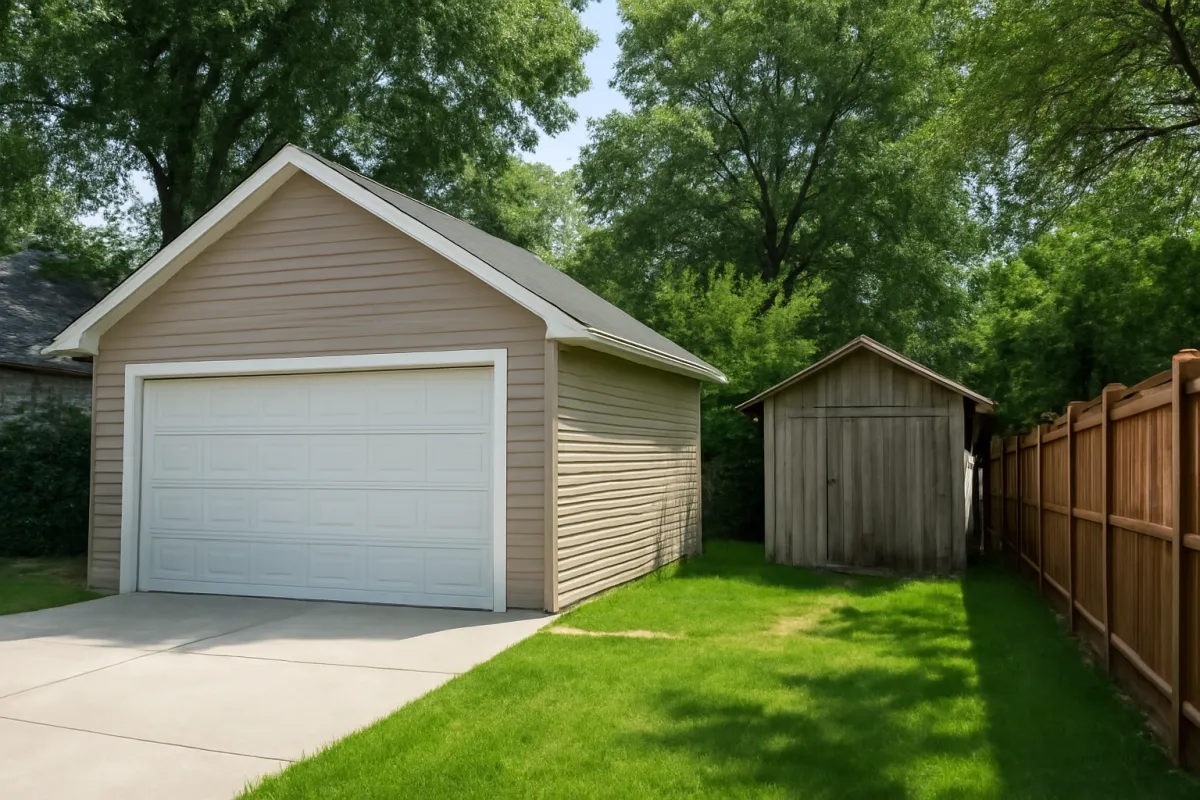
Anything standing on its own is other structures. Walk to the end of the driveway and the freestanding garage is Coverage B. The shed behind the hedge is Coverage B. The fence around the yard, the gate at the entrance, the gazebo on the lawn, the workshop at the back of the lot: Coverage B, all of it, drawing on one limit.
Edge cases exist and they are worth knowing. A structure connected to the house only by a fence, a utility line or a breezeway is generally still treated as detached, because the connection is not structural. A converted garage that was walled into the house during a renovation may have crossed the line into the dwelling, which is exactly the kind of change a policy needs to be told about. When you cannot tell, the honest answer is that your own policy wording decides it, and your agent can put the classification in writing before it matters.
What counts as an other structure
The list of what usually sits under Coverage B is longer than most homeowners expect, because it includes things that do not look like buildings at all.
- Detached garages and carports. Usually the largest and most expensive item in the category.
- Sheds, barns and outbuildings. From a small plastic garden shed to a substantial pole barn.
- Detached workshops, studios and offices. Subject to the business-use questions later in this note.
- Fences and gates. Often a large total once you price the whole run rather than one panel.
- Gazebos, pergolas, arbors and detached decks. Detached being the operative word.
- Retaining walls, garden walls and permanent yard structures. Frequently expensive to rebuild.
- Driveways, walkways and patios. Treated as other structures by many policies, handled differently by some.
- In-ground swimming pools and pool houses. Treatment varies more than any other item on this list.
- Mailbox posts, lamp posts, flag poles and permanently installed fixtures on the grounds.
A separate guest house or in-law cottage occupies its own category. It is detached and therefore reads as Coverage B, but its rebuild cost can rival a meaningful share of the main house, and its use may make it a rental exposure rather than a residential one. Structures of that scale are usually a conversation with an agent rather than something to leave to a default percentage.
What Coverage B does not cover
Coverage B has edges, and they are where the surprises live. It does not cover the land, the soil, or the grading, because land is never insured on a property policy. It does not generally cover living plants, trees, shrubs and lawns under this limit, which are usually addressed by a separate small allowance elsewhere in the policy, if at all. Our note on tree damage works through how falling trees are treated, which is a different question from whether the tree itself is insured.
It does not cover the contents of a detached structure. The tools in the shed, the lawnmower in the garage and the bicycles hanging on the wall are personal property, insured under Coverage C, not under Coverage B. Some policies apply a percentage cap on how much personal property coverage extends to a structure away from the residence, which is one more reason to know what is stored out there.
Coverage B is also not a maintenance contract. Rot, rust, insect damage, gradual settling, a fence that leaned over ten seasons and a shed roof that simply wore out are maintenance, not covered losses. And a structure used for business or rented to someone else is treated separately, which is significant enough to get two sections of its own further down.
Where the 10 percent default comes from
Ask why your other structures limit is what it is and the answer is almost never “because someone measured your property.” It is a percentage of the dwelling limit, commonly in the neighborhood of ten percent, applied by the policy form as a convenience. Set the dwelling at an illustrative $400,000 and a ten percent Coverage B arrives at $40,000 without a question being asked about what stands outside.
The convention exists because it is roughly right for the typical case it was designed around: a house with a modest shed, a short fence run and not much else. For that property, ten percent of the rebuild cost of the house comfortably exceeds the rebuild cost of everything detached, and the default quietly does its job for the entire life of the policy.
The trouble is that the percentage tracks the wrong variable. It moves with the size and cost of your house, which has no reliable relationship to the size and cost of your outbuildings. A modest home on a large rural lot with a barn, a workshop and a long fence line gets a small Coverage B limit against a large detached exposure. An expensive house with nothing behind it but a lawn gets a generous limit it will never use. Neither is a mistake by the insurer; the percentage is a starting point that expects to be adjusted, and most homeowners never adjust it. Some insurers write a lower default, some higher, and the exact percentage on your policy is a fact to read on your own declarations page rather than to assume from any article.
What detached structures actually cost to rebuild
The way to test the default is to price what stands on the lot. The chart below uses one illustrative property to make the comparison visible: a detached two-car garage, a fence line, a paved driveway, a storage shed and a gazebo, with a $40,000 Coverage B default sitting alongside them for scale.
Illustrative rebuild costs on one lot, against a 10% Coverage B default
Illustrative figures for a $400,000 dwelling limit. Construction costs vary widely by region and by build quality.
Bars are scaled to the largest item, the $52,000 garage. The five structures total $89,000 of rebuild cost against a $40,000 default limit, and the garage alone exceeds it.
Read the chart from the top and the problem states itself. The single most expensive structure on this illustrative lot costs more to rebuild than the entire Coverage B limit, before the fence, the driveway, the shed or the gazebo are counted at all. Add them and the total reaches $89,000, which is about 22 percent of the dwelling limit rather than ten. Nothing here is exotic; it is an ordinary suburban lot with a garage and a fence. The numbers are illustrative and your own will differ, but the shape of the result repeats on a great many properties.
One shared limit for every structure on the lot
The second half of the problem is that Coverage B is normally a single limit shared by everything detached, not a limit per structure. That distinction rarely matters in a fire that takes one shed. It matters enormously in the loss that actually happens to detached structures, which is weather.
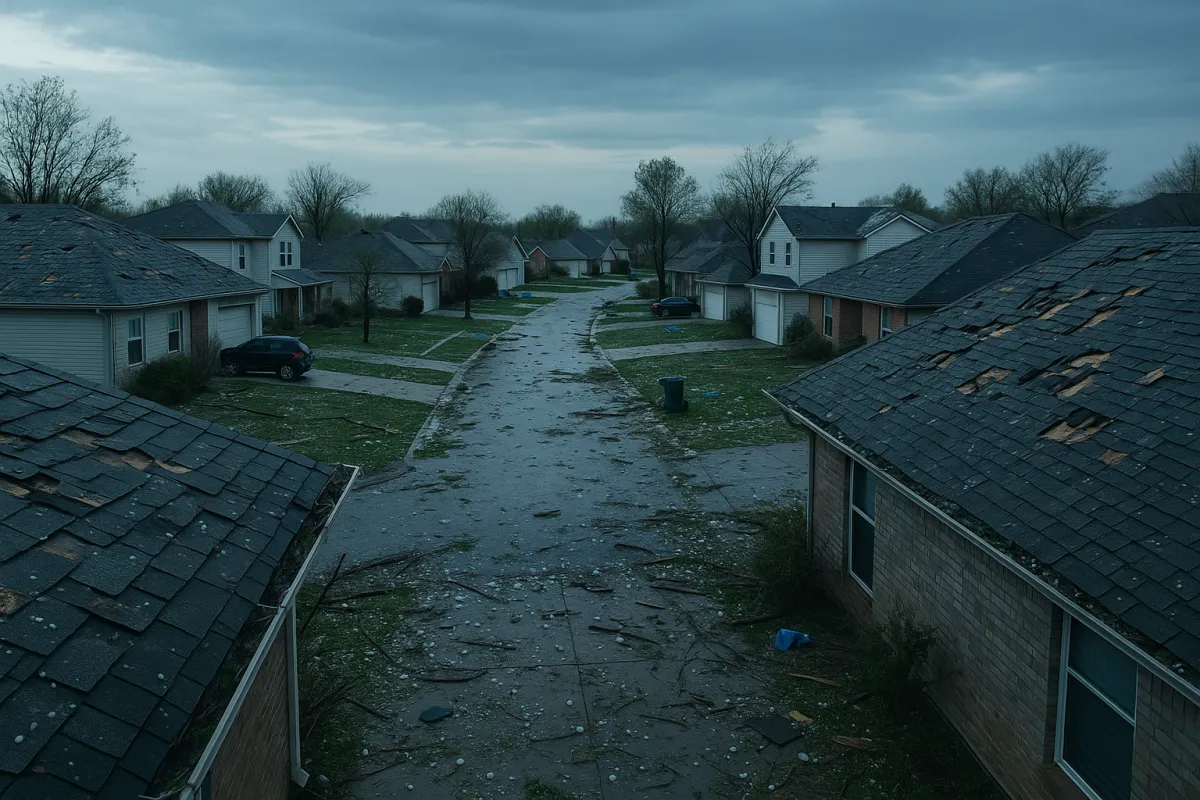
A severe wind or hail event does not select a target. It takes the garage roof, flattens a stretch of fence, drops a tree across the gazebo and pockmarks the shed in the same twenty minutes. Each of those is a covered structure, and all of them are drawing on the same pool. On the illustrative lot above, a storm that destroys the $52,000 garage and $14,000 of fencing has produced $66,000 of damage against a $40,000 shared limit, and the policy simply stops at $40,000 no matter how obviously covered the rest of it was.
This is the mechanism that converts “my shed is covered” into a shortfall, and it is invisible until the claim. It is also why sizing Coverage B against the single largest structure is not enough. The right question is not “would the limit rebuild my garage” but “would the limit rebuild everything one bad storm could reach at once.” On most properties, one event can reach all of it.
Fences, driveways and hardscape
Homeowners price the buildings and forget the flatwork, which is how the total sneaks up. A fence looks cheap because a single panel is cheap, but a full run around a suburban lot is a construction project measured in hundreds of linear feet, and replacing all of it at current material and labor prices is not a small number. The illustrative $14,000 above is not an extravagant fence; it is an ordinary one, priced whole rather than in pieces.
Driveways behave the same way. A concrete or paved driveway is one of the larger poured surfaces on a residential lot, and replacing it is a real bill. Many policies treat driveways, walkways and patios as other structures, which quietly loads more onto the shared limit. Retaining walls deserve particular attention, because a structural wall holding back a slope is expensive engineering, and its failure can be triggered by causes such as earth movement or water pressure that property policies commonly exclude. That combination, a costly structure and a frequently excluded cause of loss, makes retaining walls one of the least reliable items in the category.
The chart below shows where the money sits on the same illustrative lot, and the answer is not where most people look.
Where the $89,000 of detached rebuild cost sits
Illustrative share of total other-structures rebuild cost on one hypothetical lot. Every property differs.
The garage is the majority of the exposure, but the fence, driveway, shed and gazebo together add another $41,000, which is more than the entire illustrative $40,000 default limit.
Detached garages and why they blow the limit
If one structure is going to break your Coverage B limit on its own, it is the detached garage. It is the largest detached building on most residential lots, it is a real construction project with a foundation, framing, roof, doors and usually electrical service, and its rebuild cost scales with the same construction inflation that drives the dwelling estimate.
The arithmetic is unforgiving. On the illustrative property, a $52,000 garage sits against a $40,000 limit, so a total loss of the garage alone leaves $12,000 unfunded before the deductible is even applied. Nothing was excluded and nothing was denied; the structure was covered, and the limit simply ran out.
Garages also tend to appreciate in rebuild cost faster than owners notice, because upgrades accumulate. A finished interior, insulation, a heater, an upgraded electrical panel, a workshop bench, an automatic door opener and a second story for storage all raise what it costs to put the building back, and none of them prompts a call to the insurer. If your detached garage has been improved since the policy was written, its rebuild cost has moved and the ten percent default has not.
Sheds, gazebos, pergolas and outdoor kitchens
Smaller detached structures are individually inexpensive and collectively significant. A garden shed, a gazebo, a pergola over the patio, an outdoor kitchen, a detached pizza oven, a play structure with a permanent foundation: each one adds a few thousand dollars of rebuild cost to a limit that was never adjusted for any of them.
There is also a classification question with the cheapest end of this category. A small prefabricated shed sitting on the ground without a foundation, a portable canopy, or a temporary structure may be treated by some policies as personal property rather than as an other structure, which changes both the limit it draws on and how it settles. That is a wording question with no universal answer, and the practical response is to ask which side of the line your specific structure falls on before you need to know.
The general principle holds for all of them: outdoor structures have gotten more elaborate and more expensive over the past couple of decades, while the ten percent convention has not moved at all. A backyard that would have held a shed and a swing set in an earlier era may now hold a covered kitchen, a pergola and a hot tub deck, and the default percentage does not know that.
Pool houses, pools and the fine print around water
Pools are the least predictable item in the whole category. Some policies treat an in-ground pool as an other structure covered under Coverage B, some address it under separate wording, some exclude specific causes of loss for pools, and some treat above-ground pools entirely differently from in-ground ones. A pool house or cabana is more consistently treated as an other structure, because it is plainly a building, but it also carries a substantial rebuild cost that the default percentage almost certainly did not contemplate.
The variation here is wide enough that any confident general statement would be wrong for a large number of readers, so this note will not make one. What is safe to say is that a pool represents a large, expensive, permanently installed structure whose insurance treatment differs meaningfully between carriers and states, and that reading the actual policy language on it is worth the ten minutes.
Pools also carry a liability dimension that has nothing to do with Coverage B. An attractive nuisance on the property raises the stakes on the liability side of the policy entirely separately from whether the pool structure itself is insured, which our note on Coverage E personal liability works through in detail. Property coverage and liability coverage answer different questions about the same pool.
Structures used for business
Business use is the most common way a detached structure quietly falls outside a homeowners policy. Standard homeowners forms are written for personal residential exposures, and structures used for business purposes are frequently excluded, limited or conditioned. The workshop where you refinish your own furniture and the workshop where paying customers drop off pieces look identical from the street and read very differently in policy language.
The reason is not that insurers dislike side businesses. It is that a business exposure brings different risks: customers or employees on the premises, inventory and equipment, tools that belong to clients, and liability that a personal policy was never rated for. A homeowners policy that covered all of that at homeowners prices would be mispriced, so the forms carve it out and route it to a separate solution.
The fixes are ordinary and usually inexpensive. A home business endorsement can extend a homeowners policy for modest exposures, and a business owner policy handles larger ones. Which applies depends on the scale and nature of the work, and the wording differs enough by insurer and state that only your own agent can answer it. Our walkthrough on insuring a home-based business covers the sequence. The one thing not to do is guess, because a detached structure whose use was never disclosed is exactly the fact an adjuster discovers at the claim.
Structures you rent to someone else
Renting out a detached structure changes its insurance character in the same way business use does. A garage apartment let to a tenant, a backyard cottage on a short-term rental platform, a barn rented for storage, a studio leased to an artist: each of these converts a personal residential structure into an income-producing one, and standard homeowners forms commonly limit or exclude structures rented or held for rental to others.
Occasional and incidental use is treated differently from a standing rental arrangement in many forms, but “occasional” is doing a lot of work in that sentence and its meaning is set by policy wording rather than by common sense. A room let to a long-term houseguest, a garage rented for a neighbor’s boat over one winter and a cottage listed year-round on a booking site are three different exposures with three different answers.
The solution is usually a landlord policy for the rental exposure or an endorsement extending the homeowners form, and our note on landlord insurance explains what that structure covers. The step that matters most comes first: tell the insurer what the structure is actually used for, in writing, before a loss rather than during one.

How a Coverage B claim is settled
Three things decide what a Coverage B claim actually pays, and the limit is only one of them. The first is whether the cause of loss is covered at all, which follows the perils named or excluded elsewhere in the policy. The second is the settlement basis, replacement cost or actual cash value. The third is the deductible, which applies here exactly as it does to a dwelling claim.
On a replacement cost basis, a covered loss pays what it costs to rebuild the structure with comparable materials at current prices, capped by the Coverage B limit and reduced by the deductible. On an actual cash value basis, the rebuild cost is depreciated for the age and condition of the structure first, and the smaller depreciated figure is what the limit and deductible are then applied to. Our note comparing actual cash value and replacement cost works the mechanics in full.
The detail that catches people is that these two bases can differ between coverages on the same policy. A policy can settle the dwelling on replacement cost while settling detached structures, or specific categories such as fences and sheds, on actual cash value. Some forms depreciate outbuildings by default. There is no universal rule here, and the only way to know is to read the settlement provisions on your own policy and ask the insurer to confirm how Coverage B is written.
Depreciation on an aging outbuilding
Depreciation hits detached structures harder than it hits houses, for a simple reason: outbuildings are usually older, less maintained and built to a lower standard than the residence, so the depreciation factor applied to them is larger.
Work the illustrative garage through it. A detached garage with a $52,000 replacement cost, 18 years into an assumed 40-year useful life, has depreciated roughly 45 percent on a straight-line calculation, leaving an actual cash value of about $28,600. That is $23,400 less than the replacement cost, and it is the number the limit and deductible then get applied to. The structure was fully covered, the claim was fully approved, and the check is a little more than half the cost of rebuilding.
Depreciation methods vary and adjusters apply judgment about condition, so treat the straight-line arithmetic as an illustration of the mechanism rather than a prediction of your outcome. The mechanism is what matters: on an actual cash value basis, the older the structure, the further the payout sits from the rebuild cost, and detached structures are the oldest things on most properties.
Which deductible applies to a Coverage B claim
Your standard property deductible generally applies to an other structures claim, the same one that would apply to a dwelling loss. That has a specific consequence for small detached structures: a fence section, a damaged gate or a dented shed can produce a repair bill close to or below the deductible, which makes the claim not worth filing even though it is plainly covered. Our explainer on deductibles works through where that break-even sits.
Percentage deductibles complicate this further. Where a policy carries a separate wind, hail, hurricane or named-storm deductible calculated as a percentage of the dwelling limit, that larger deductible can apply to the perils most likely to damage detached structures in the first place. A wind deductible sized against a $400,000 dwelling limit can be several thousand dollars, applied to a fence claim worth a fraction of that. Our note on wind and hail deductibles covers how those are calculated and when they trigger.
The practical reading is that Coverage B claims skew toward two extremes. Small detached losses often fall under the deductible and get absorbed. Large ones run into the shared limit. The comfortable middle where the coverage works exactly as imagined is narrower than it looks.
Which perils Coverage B responds to
Other structures coverage generally responds to the same perils the rest of the property section does, which on most homeowners forms means fire, lightning, windstorm, hail, explosion, falling objects, vehicle impact, vandalism and theft of the structure itself, along with the other listed causes. Whether your policy names covered perils or covers everything except listed exclusions changes the analysis, and the two structures appear on different policy forms.
Weather dominates the actual claim experience for detached structures, because outbuildings are exposed on every side and built lighter than houses. Wind takes fences and garage roofs. Hail takes shed roofs and skylights. Falling trees take gazebos and garage corners. Vehicles reverse into detached garages and fence posts with striking regularity.
Two exclusions deserve special mention for this category. Earth movement can undermine retaining walls and driveways, and is excluded on standard forms. Water damage rules that apply to the dwelling apply here too, so gradual seepage into a shed floor is maintenance rather than a claim. Our overview of what home insurance covers maps the peril structure across the whole policy.
Flood and earthquake follow the dwelling exclusions
Flood and earthquake are excluded from standard homeowners policies, and that exclusion applies to detached structures exactly as it applies to the house. A flood that destroys a detached garage is not a Coverage B claim; it is a flood claim or it is nothing.
Detached structures are also treated distinctly under separate flood coverage, and the treatment is not always what owners expect. Flood policies commonly handle detached garages differently from other outbuildings, and a shed, a fence or a pool house may need its own separate flood policy rather than riding along on the one covering the house. Because those rules are set by programme and policy terms that change, this note points you to the source rather than asserting the current specifics: read the declarations and the policy form for the flood coverage you actually hold, and ask the writing agent how each detached structure on your lot is treated. Our note on flood insurance in high-risk areas explains the general structure, and our earthquake coverage note does the same on that side.
The takeaway is a gap worth checking deliberately. A homeowner who bought flood or earthquake coverage for the house and assumed the outbuildings came along may find the outbuildings were never included at all.
How to raise your other structures limit
Coverage B is one of the easiest limits on a homeowners policy to increase, and one of the least often increased. In most cases it is a phone call: you tell the insurer what the detached structures on the property are worth to rebuild, and the limit is raised either to a higher percentage of the dwelling amount or to a specific scheduled figure.
Three routes are typically available, though what your insurer offers varies. The first is raising the percentage, moving Coverage B from the default to a higher share of the dwelling limit. The second is a specific increased limit expressed in dollars rather than as a percentage, which is the cleaner approach when one structure dominates the exposure. The third is scheduling an individual structure separately, which some insurers offer for substantial outbuildings such as a barn, a guest cottage or a large workshop, and which can also let that structure be written on terms the blanket limit does not offer.
Alongside the limit, ask two more questions. Ask whether Coverage B is settled on replacement cost or actual cash value, and what it would take to move it to replacement cost if it is not. And ask whether any inflation-adjustment provision that moves the dwelling limit each year carries the other structures limit up with it, or whether a specific increased limit stays frozen where you set it.
What a higher limit typically costs
The reason this correction is worth making is that other structures coverage is inexpensive relative to what it protects. Property coverage is broadly priced per thousand dollars of limit, and detached structures are a smaller and more contained exposure than the residence, so adding limit here tends to be one of the cheaper adjustments available on a homeowners policy.
Work the illustrative property through it. Closing the gap between the $40,000 default and the $89,000 of actual rebuild cost means adding $49,000 of limit. At an illustrative rate of $2.50 per $1,000 of coverage, that is about $123 a year, against $49,000 of exposure that was previously sitting uninsured. The rate is an illustration only; real rates depend on your carrier, your location, your construction and your claims history, and the only figure that means anything is the one your own insurer quotes.
The comparison is still worth making, because the shape of the trade rarely changes. A modest annual amount buys back a shortfall that would arrive in a single storm. Set against the other ways to spend the same money on a policy, raising an under-set Coverage B limit is usually among the highest-value adjustments on the page, and our note on lowering premiums is worth reading alongside it so the increase is funded rather than simply added.
How to inventory the detached structures on your lot
The whole exercise comes down to one afternoon with a notepad. Walk the property boundary and write down every structure that is not attached to the house, including the things that do not look like structures: the fence, the gate, the driveway, the walkway, the retaining wall, the lamp post, the mailbox.
Then price each one at what it would cost to build new today, not what you paid and not what it is worth used. For buildings, a local contractor can give you a per-square-foot figure for the type of construction. For fencing, measure the run in linear feet and multiply by a current per-foot installed price. For flatwork, measure the area and use a current per-square-foot installed price. Rough is fine; the goal is to land in the right range, not to be exact.
Add the total and compare it to the Coverage B figure on your declarations page. Then take photographs of each structure while you are out there, because documentation gathered before a loss is worth many times documentation attempted afterward. Our walkthrough on building a home inventory applies the same discipline to contents, and the outdoor version takes an hour. Run your dwelling figure through our replacement-cost estimator at the same sitting so both numbers are current together.

Reading Coverage B on your declarations page
Everything abstract about this coverage becomes concrete on the declarations page, the summary sheet at the front of your policy. Coverage B appears there, labeled “Other Structures” or “Coverage B,” with a dollar amount beside it, usually directly under the dwelling line. Our line-by-line walkthrough of the declarations page covers the whole document; here are the questions specific to this coverage.
Check the dollar amount against your own inventory total, not against the percentage. Check whether the amount is expressed as a percentage of Coverage A or as a specific dollar figure, because that determines whether it moves with inflation adjustments. Check the settlement basis stated for Coverage B, and whether it differs from the dwelling. Check which deductible applies, including any separate wind, hail or named-storm deductible.
Then look for what is not there. A pool, a guest cottage, a barn or a business-use structure that you know exists on the property and that appears nowhere in the policy documents is a fact the insurer may not have. Structures added after the policy was written are the most common gap, because nobody thinks to report a new fence or a new shed. If the insurer’s picture of your property is out of date, the limit was calculated against the wrong property.
Coverage B on condo, renters and landlord policies
Other structures coverage is not exclusive to standard homeowners forms, but it looks different everywhere else. On a condominium policy, the detached structures on the grounds belong to the association and are insured by the association’s master policy, not by yours, so the unit owner’s form addresses a much narrower set of property. Our condo insurance note explains where the master policy stops and yours begins.
On a renters policy there is generally no other structures coverage at all, because a tenant does not own the buildings. A renter insures belongings and liability, and the detached garage belongs to the landlord’s policy. Our renters insurance note covers what a tenant form does include.
On a landlord policy, detached structures on the rental property are covered under the landlord form rather than under a homeowners form, and the sizing question is the same one this note has been making throughout: the default percentage was calculated from the building, not from the lot. Owners of small multi-unit or single-family rentals with detached garages, sheds or fencing face exactly the same shortfall, with the added complication that a rental property’s structures are frequently older.
Common other structures coverage mistakes
The same handful of errors accounts for most of the pain at claim time.
- Accepting the default percentage without pricing the lot. The percentage tracks your house, not your outbuildings, and the two are unrelated.
- Sizing to the largest structure only. Coverage B is normally one shared limit, and one storm can reach every structure at the same time.
- Forgetting the fence, driveway and hardscape. They do not look like buildings and they are frequently a third of the total.
- Assuming replacement cost applies. Some policies depreciate outbuildings even when the dwelling settles on replacement cost.
- Never reporting a new structure. A shed, a fence or a garage added after the policy was written may be invisible to the insurer.
- Not disclosing business or rental use. This is the exclusion most likely to turn a covered structure into an uncovered one.
- Assuming flood or earthquake coverage extends to outbuildings. Detached structures are often treated separately and may need their own coverage.
Each of these costs nothing to check and can cost a large share of a rebuild to ignore. All of them are checkable in one evening with the declarations page and a notepad.
A worked example: one lot, one storm, one shared limit
Pull the pieces together on the illustrative property. The house carries a $400,000 dwelling limit, so a ten percent Coverage B default gives $40,000. The lot holds a detached two-car garage with a $52,000 rebuild cost, a fence line at $14,000, a concrete driveway at $12,000, a storage shed at $6,000 and a gazebo at $5,000, for $89,000 of detached rebuild cost. The default funds about 45 percent of it, and the true requirement is closer to 22 percent of the dwelling limit than to ten. The deductible is $1,000.
Now run a storm through it. Wind destroys the garage and takes down $14,000 of fencing: $66,000 of covered damage against a $40,000 shared limit. If Coverage B is written on replacement cost, the policy pays the $40,000 limit less the $1,000 deductible, so $39,000 arrives against $66,000 of work and $27,000 lands on the homeowner. If instead the garage settles on actual cash value at 18 years into an assumed 40-year life, its $52,000 rebuild depreciates to about $28,600 before the limit and deductible are applied, and the garage portion of the claim pays roughly $27,600 rather than the $51,000 an uncapped replacement cost settlement would have produced on that structure alone.
The correction costs a fraction of the shortfall. Raising the limit from $40,000 to $89,000 adds $49,000 of coverage, which at an illustrative $2.50 per $1,000 is roughly $123 a year. Every figure here is an illustration built to show the mechanism, and your own carrier’s limit, percentage, settlement basis and rate are the only ones that decide your claim. Run your dwelling number through our replacement-cost estimator, then read the Coverage B line on your declarations page and see which side of this example your property is on.
The bottom line
Other structures coverage is the part of a homeowners policy that almost nobody chooses and almost everybody has, arriving automatically as a percentage of a number calculated for the house rather than for the lot. It insures the detached garage, the shed, the fence, the gate, the gazebo and often the driveway, usually under one shared limit that a single storm can reach all of at once. When the property holds nothing but a small shed, the default is generous and nothing needs doing. When the property holds a real detached garage and a real fence line, the default can fund less than half of what a rebuild would cost, and the gap only becomes visible on the day it is too late to close.
The fix is unglamorous and cheap. Walk the property, price each structure at what it would cost to build new, add the total, and compare it to the Coverage B line on your declarations page. Ask how that coverage settles and whether it matches the dwelling. Tell the insurer about business use, rental use and anything built since the policy was written. Then raise the limit if the numbers say to, which on most policies costs a small annual amount against an exposure measured in tens of thousands. Coverage B is the easiest coverage on a homeowners policy to fix and the one most likely to be wrong, and those two facts together are the reason it deserves an afternoon of your attention.
SumSured publishes coverage notes like this one for education, not as insurance advice. The percentages, rebuild costs, depreciation figures, rates per thousand and claim outcomes described above are illustrations chosen to show how the mechanics work, not quotes and not predictions of how any particular claim will be paid. Whether a specific structure counts as an other structure, which perils apply, whether outbuildings settle on replacement cost or actual cash value, and how business or rental use is treated are all set by your own policy wording and by the rules of your state. Read your declarations page and your policy form, then confirm anything that matters with a licensed insurance professional before you rely on it.
Frequently asked questions
What is other structures coverage?
Other structures coverage, listed as Coverage B on a standard homeowners policy, is the part that pays to repair or rebuild structures on your property that are not attached to the main house. A detached garage, a storage shed, a fence, a gazebo, a detached workshop, and in many policies a driveway or a retaining wall sit under Coverage B rather than under dwelling coverage. It is usually included automatically and set as a percentage of your dwelling limit rather than priced against an inventory of what actually stands on your lot. That derivation is the reason the limit so often fails to match reality, and it is the reason this coverage note exists.
What counts as an other structure?
The usual test is attachment. If a structure is physically joined to the house, it tends to fall under dwelling coverage, and if it stands on its own it tends to fall under other structures. That puts a freestanding garage, a shed, a barn, a detached workshop or studio, a gazebo, a pergola, a fence, a gate, a retaining wall, a mailbox post, and a detached carport on the Coverage B side of the line. Driveways, walkways and in-ground pools are treated as other structures by many policies, though some handle them under separate wording or exclude them. Because the treatment of hardscape and pools varies more than the treatment of buildings, check your own policy language rather than assuming.
How much other structures coverage do I need?
Enough to rebuild every detached structure on the lot at current construction prices, which is a number you can only reach by adding them up. The common default is a percentage of the dwelling limit, often around ten percent, and it is applied without anyone checking it against your property. On a lot with only a small shed the default is usually generous. On a lot with a detached garage, a long fence line, a paved driveway and an outdoor structure or two, the total rebuild cost can run well past the default. The honest method is a walk around the property with rough replacement costs written down, then a comparison against the Coverage B figure on your declarations page.
Does home insurance cover a detached garage?
A detached garage is generally covered, but under other structures coverage rather than under the dwelling limit, and that distinction decides how much money answers the loss. Coverage B is typically a single shared limit for everything detached on the property, so a detached garage that costs more to rebuild than the whole Coverage B limit leaves a shortfall even though the structure itself was plainly covered. A detached garage is also the structure most likely to consume the limit on its own, because it is usually the largest and most expensive detached building on a residential lot. If yours is substantial, that is the strongest reason to price the limit rather than accept the default.
Does home insurance cover a fence?
Fences are generally treated as other structures and covered for the same perils as the rest of the policy, which means a fence blown down by wind or crushed by a falling tree usually has a path to a claim while a fence that simply rotted or leaned over the years does not. Two practical points matter more than the coverage question. First, fence damage often settles on an actual cash value basis in policies that depreciate outbuildings, so an older fence can pay far less than a new one costs. Second, a fence claim runs through the same deductible as any other property claim, and many fence losses land close to or below a typical deductible.
Is other structures coverage separate from dwelling coverage?
Yes. Dwelling coverage (Coverage A) and other structures coverage (Coverage B) are separate limits that are typically listed on separate lines of the declarations page, even though the second is usually calculated as a percentage of the first. A loss to the house draws on the dwelling limit and a loss to a detached structure draws on the other structures limit, and one does not top up the other. That separation is why a homeowner with a generous dwelling limit can still be short on a detached garage: the large number on the page was never available to that structure in the first place.
Does other structures coverage pay replacement cost or actual cash value?
It depends on how your policy is written, and the two produce very different checks on an aging outbuilding. On a replacement cost basis, a covered loss pays what it costs to rebuild the structure with comparable materials at current prices, subject to the limit and the deductible. On an actual cash value basis, the payout is reduced for age and wear before anything is paid, which on a structure well into its expected life can be a substantial cut. Some policies settle the dwelling on replacement cost while settling detached structures, or specific items such as fences and sheds, on actual cash value. That asymmetry is worth confirming on your own policy rather than assuming it matches the dwelling.
Does other structures coverage cover a shed used for a business?
Business use is the most common way a detached structure quietly falls outside standard other structures coverage. Homeowners policies are written for personal residential exposures, and a structure used for business, rented to a tenant, or held out for commercial purposes is frequently excluded, limited, or subject to conditions on a standard form. A workshop where you occasionally repair your own furniture reads very differently from a workshop where customers drop off paid work. The wording differs by insurer and by state, so the reliable move is to describe the actual use to your agent before a loss and ask in writing how the policy treats it, then add the endorsement or the separate commercial policy the answer points to.

Hamza Hai is the editor of SumSured. She holds an MBA and reviews the site's articles against our editorial standards, checking that every figure is labelled for what it is, that nothing is presented as verified fact without a source the reader can check, and that the writing stays useful to a non-specialist.