What's in this note
- What hazard insurance actually is
- Hazard insurance vs homeowners insurance
- Why the word “hazard” trips people up
- Why mortgage lenders require hazard insurance
- What perils hazard insurance covers
- What hazard insurance excludes
- Is hazard insurance the same as dwelling coverage?
- Named perils versus open perils on the structure
- How your hazard coverage amount is calculated
- Replacement cost versus actual cash value on the structure
- Hazard insurance versus full homeowners insurance, side by side
- How hazard insurance fits the coverage stack
- Do you need separate hazard insurance?
- Force-placed hazard insurance: the expensive trap
- Hazard insurance and escrow: how the premium actually gets paid
- What is hazard insurance on a condo, townhouse, or mobile home
- How to show proof of hazard insurance to your lender
- How much hazard coverage should you carry
- Common misconceptions about hazard insurance
- A worked example: the hazard portion on one home
- The bottom line
Short answer: Hazard insurance is the structural part of a homeowners policy, the coverage that pays to repair or rebuild the physical building after a covered peril such as fire, wind, hail, or lightning. It is usually not a separate policy: when a lender requires hazard insurance, a standard homeowners policy already satisfies it, and in everyday use the term means dwelling coverage (Coverage A). It covers only the structure and excludes flood and earthquake.
What is hazard insurance? Hazard insurance is the part of a homeowners insurance policy that pays to repair or rebuild the physical structure of your home after damage from a covered peril such as fire, wind, hail, or lightning. It is the protection that answers the loss when the building itself is damaged, and it is almost certainly the coverage your mortgage lender means when it requires “hazard insurance” as a condition of your loan. The word sounds like a separate product you have to go out and buy, and that impression causes a great deal of unnecessary confusion. In the vast majority of cases it is not separate at all: it is a component built into the standard home insurance policy you already carry.
This coverage note untangles the term end to end: what hazard insurance is and what it covers, why lenders require it, how it relates to the dwelling coverage line on your policy, which perils it does and does not respond to, how the amount is calculated, and the single question most people actually want answered, whether they need to buy a separate hazard policy at all (usually, no). Along the way it draws clean lines between hazard insurance and the full homeowners policy that contains it, so the next time the word appears on a loan document or an escrow statement, you know exactly what it is asking for. You can get a starting rebuild figure for your own home in about a minute with our replacement-cost estimator.
Key takeaways
- Hazard insurance is the structural component of a homeowners policy: it pays to repair or rebuild the physical building after a covered peril like fire, wind, or hail.
- It is usually not a separate policy. When a lender requires hazard insurance, a standard homeowners policy already satisfies it, so you rarely need to buy anything extra.
- Hazard insurance is closely tied to dwelling coverage (Coverage A): in everyday use the two terms point to the same structural protection and the same dollar limit.
- Lenders require it because your home is their collateral. They want proof the structure can be rebuilt, insured to replacement cost, for the life of the loan.
- It covers the structure only, not your belongings, liability, or the land, and it excludes flood and earthquake, which need their own separate coverage.
What hazard insurance actually is
Hazard insurance is the coverage that protects the physical structure of your home against damage from hazards, the sudden and accidental perils that can strike a building. On a standard homeowners policy this protection lives in the dwelling coverage line, and it responds when a covered peril damages the house itself: the frame, roof, walls, floors, foundation, and the systems built into the structure. If a kitchen fire guts a wing of the house or a windstorm tears off the roof, hazard insurance is the part of your policy that pays to put the building back, up to your coverage limit and after your deductible.
The reason the term exists at all is mostly historical and lender-driven. Mortgage documents, escrow statements, and loan estimates frequently use “hazard insurance” as shorthand for the structural protection a lender insists on before it will lend against a home. The phrase describes a function rather than naming a product on a shelf. That is the key to reading it correctly: hazard insurance is not a rival to homeowners insurance and not usually a separate purchase, it is a description of what one important slice of your homeowners policy does. Understanding that single fact resolves most of the confusion the term creates, and the rest of this note works outward from it.
Hazard insurance vs homeowners insurance
The cleanest way to hold the two terms apart is to think of size. Homeowners insurance is the whole package. Hazard insurance is one piece inside it. A standard homeowners policy bundles several distinct coverages together: structural protection for the building, personal property coverage for your belongings, other structures coverage for detached buildings, loss of use coverage for living costs during a rebuild, and personal liability and medical payments coverage for injuries and lawsuits. Hazard insurance refers only to the first of those, the structural protection against physical perils.
So the two are not competing products and they are not interchangeable, even though people often use “hazard insurance” and “homeowners insurance” as if they meant the same thing. Homeowners insurance contains hazard insurance the way a car contains an engine: the engine is essential and central, but it is not the whole car, and you do not buy it separately when you already own the car. When a lender asks whether you have hazard insurance, it is asking whether the structural component exists and is adequate. A normal homeowners policy answers yes automatically, because that component is built in. Our coverage note on what home insurance covers walks the full set of coverages a homeowners policy bundles; this note stays on the structural piece and the confusion around its name.
Why the word “hazard” trips people up
Almost all the confusion around hazard insurance comes from where people encounter the term. You rarely hear it from a friend describing their home policy; you hear it from a mortgage lender, a title company, or an escrow statement, in language that sounds official and product-specific. A loan estimate might list an annual “hazard insurance” cost, an escrow analysis might show a “hazard insurance” disbursement, and a closing checklist might demand proof of “hazard insurance” before the deal can fund. Reading those documents, it is easy to assume hazard insurance is a distinct thing you have to shop for separately from your homeowners policy.
It is not. In nearly every case the lender is using an older, narrower phrase for the structural coverage inside the homeowners policy you are already buying. The lender cares specifically about the building because the building is what secures the loan, so it uses a word that points at the structure rather than at the whole package. Once you know that “hazard insurance” on a loan document almost always translates to “the dwelling coverage in your homeowners policy,” the paperwork stops being alarming. You do not need to buy anything extra to satisfy it. You need to make sure your homeowners policy exists, that its structural limit is high enough, and that your lender has proof of it, which the following sections cover in turn.
Why mortgage lenders require hazard insurance
A mortgage lender requires hazard insurance for a straightforward reason: your home is the collateral for the loan, and the lender needs that collateral to survive. When you borrow to buy a house, the lender is fronting most of the money against the value of the property. If the house burned down uninsured, the lender would be left holding a loan secured by a lot with a pile of ash on it, and a borrower who now has every incentive to walk away. Requiring hazard insurance guarantees that if the structure is destroyed, insurance money exists to rebuild it, protecting the asset the loan is written against.
That is why lenders are specific about the structural coverage rather than the rest of the policy. They generally require you to insure the building to at least its full replacement cost, the amount it would take to rebuild, so the collateral can actually be restored rather than partly restored. They also require to be listed on the policy, usually as the mortgagee, so they are notified if the policy lapses and are named on large claim checks to ensure the money goes toward rebuilding. The requirement lasts for the life of the loan: let the coverage lapse and the lender can step in and buy its own far more expensive policy on your behalf, a situation covered later in this note. Understanding the lender’s motive makes the requirement feel less like red tape and more like what it is, a condition tied directly to the thing you both have a stake in.

What perils hazard insurance covers
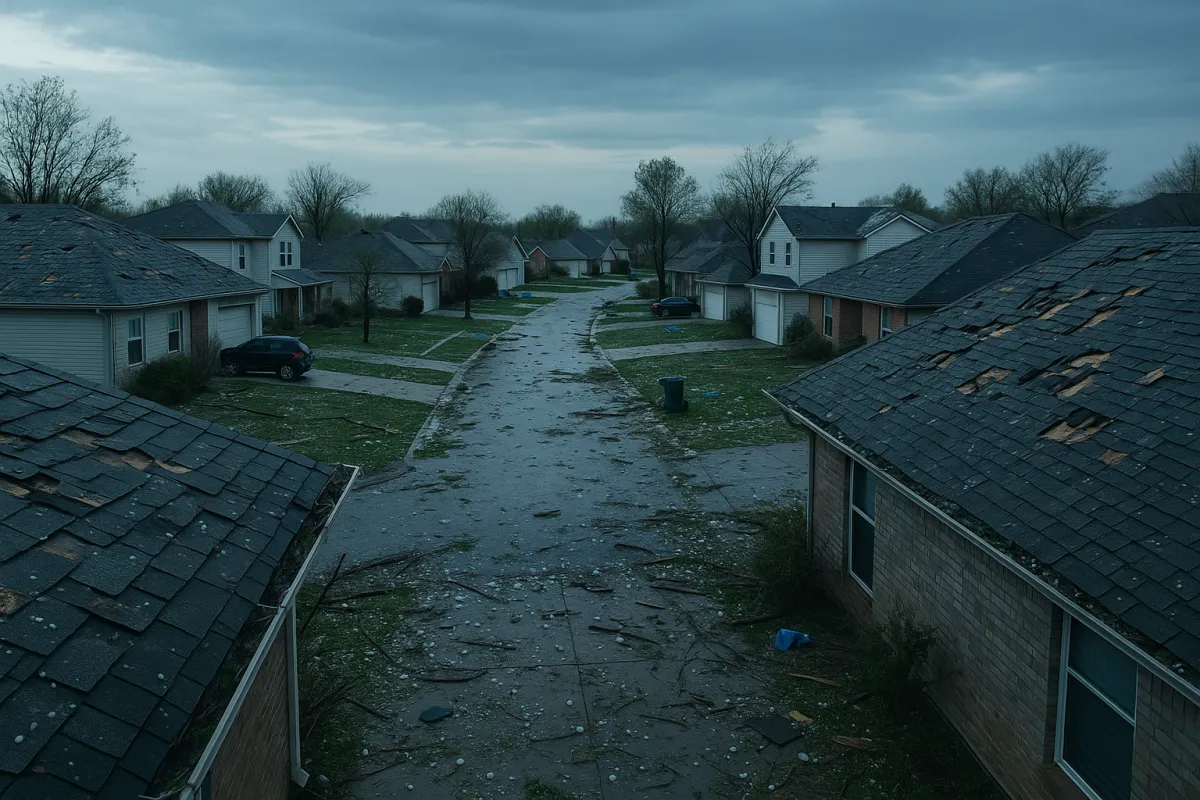
Hazard insurance covers physical damage to the structure from the perils a standard policy names as covered. While the exact list varies by policy form and insurer, the commonly covered perils include fire and smoke, lightning, windstorm and hail, explosion, riot, damage from aircraft or vehicles, falling objects such as a tree limb, the weight of ice, snow, or sleet, vandalism and malicious mischief, and certain sudden and accidental water damage originating inside the home, such as a burst pipe. When one of these perils damages the building, hazard insurance pays to repair or rebuild the affected structure, subject to your limit and deductible.
The unifying theme across covered perils is that they are sudden and accidental events that strike the structure, not gradual processes or predictable wear. A roof torn off by a windstorm is a covered hazard; a roof that simply reached the end of its service life is a maintenance expense the policy does not pay for. A pipe that bursts suddenly is generally covered; a slow leak that seeped for months and rotted a wall reads as neglected maintenance and is typically excluded. That line between the sudden covered event and the gradual excluded one runs through nearly every claim decision, and it is worth internalizing before a loss rather than discovering it during one. The next section takes the other side of the coin, the perils and property that hazard insurance leaves out.
Which perils drive structural (hazard) claims
Illustrative share of covered structural losses by peril type. Every region and year differs.
Illustrative only, to show that wind, hail, and fire dominate structural claims while other named perils fill the remainder. Bars are scaled to the largest share. Your policy's covered perils and your regional mix will differ.
What hazard insurance excludes
Just as important as the covered perils is the list of things hazard insurance deliberately leaves out, because the exclusions are where homeowners are most often surprised. Two perils in particular are excluded from standard policies almost universally: flood and earthquake. Flooding from outside the home, the rising water of a storm surge, an overflowing river, or heavy runoff, is not covered by hazard insurance at any limit; it requires a separate flood policy, and our coverage note on what flood insurance costs by risk zone puts illustrative numbers on that separate purchase. Earth movement, including earthquakes and landslides, is likewise excluded and needs its own coverage or endorsement. No amount of hazard insurance fills these gaps, which is why homeowners in flood-prone or seismically active areas have to arrange coverage specifically.
Beyond those two, hazard insurance excludes losses that are not sudden and accidental. Wear and tear, gradual deterioration, rot, mold from a long-ignored leak, pest and insect damage, and general lack of maintenance are the homeowner’s responsibility, not the insurer’s, because they are maintenance rather than a covered event. Damage from neglect, intentional acts, and certain excluded causes such as government action or ordinary settling of the foundation also fall outside the coverage. And crucially, hazard insurance does not cover things that are not the structure at all: your belongings, your liability to others, and the land itself sit under different parts of the policy or are not insured. The next few sections draw those boundaries precisely, starting with the closest relationship of all, the one between hazard insurance and dwelling coverage.
Is hazard insurance the same as dwelling coverage?
For practical purposes, yes, hazard insurance and dwelling coverage describe the same protection, and in everyday conversation the terms are used interchangeably. Dwelling coverage, listed as Coverage A on a standard homeowners policy, is the specific policy line that pays to repair or rebuild the physical structure of your home after a covered loss. Hazard insurance is the broader, less technical word for exactly that structural protection against perils. When a lender demands proof of hazard insurance, the number it wants to verify is almost always your dwelling coverage limit, the Coverage A amount on your declarations page.
The only meaningful distinction is one of language rather than substance. Dwelling coverage is the precise, policy-native term: it names a specific coverage line (Coverage A) and a specific dollar limit (the dwelling limit). Hazard insurance is the functional, lender-facing term: it names what the coverage does, protect the structure from hazards, without pointing at a particular policy line. Because they line up so closely, satisfying your dwelling coverage requirement satisfies the hazard insurance requirement in nearly every case. If you want the full mechanics of Coverage A, how it is sized, what it includes and excludes, and how claims settle, our coverage note on dwelling coverage goes deep on that specific line; here, the point is simply that hazard insurance and dwelling coverage are two names for one thing.

Named perils versus open perils on the structure
There is one layer of nuance worth adding to how hazard insurance covers the structure, because it changes which losses actually get paid. Policies cover the building on one of two bases: named perils or open perils. A named-perils basis covers only the specific perils the policy lists, so if the cause of damage is not on the list, it is not covered. An open-perils basis, sometimes called all-risk or special form, covers any sudden and accidental cause of loss except those the policy specifically excludes, which flips the logic: instead of proving your peril is on a list, the loss is covered unless the insurer can point to an exclusion.
For the structure of the home, most modern homeowners policies use the broader open-perils basis, which is why owners tend to think of their structural coverage as covering nearly everything sudden. That breadth is real, but it lives entirely inside the exclusions: flood, earthquake, wear and tear, neglect, and the other excluded causes still apply no matter how broad the base. The distinction matters most when comparing policies or reading a less common form, because a named-perils policy on the structure is meaningfully narrower than an open-perils one, even though both would be described loosely as hazard insurance. When you review your coverage, it is worth confirming which basis applies to the dwelling, since it decides whether the burden falls on you to prove the peril or on the insurer to prove the exclusion.
How your hazard coverage amount is calculated
The amount of hazard insurance you carry is set by the cost to rebuild your home’s structure, not by its market value or your loan balance. When you buy or renew a policy, the insurer estimates a replacement cost using a valuation tool that takes in your home’s characteristics: square footage, number of stories, construction type and exterior materials, roof type, the count and quality of bathrooms and kitchens, foundation type, and any custom or high-end features, all priced against local construction costs. The output is an estimated rebuild figure, and that figure becomes your dwelling (hazard) limit, the maximum the policy will pay to reconstruct the structure.
The base of that estimate is size times a local building rate: the square footage that has to be rebuilt multiplied by a cost per square foot that varies by region and drifts over time. On top of that base, the quality and complexity of the build, the home’s systems and features, its age, and local labor and material prices push the number up or down. Because those inputs change and construction prices rise, the estimate is a moving target rather than a one-time calculation, which is exactly how careful owners drift into being underinsured without doing anything wrong. The accuracy of the figure depends on how accurately your home’s details went into it, so it is worth confirming the insurer knows about renovations, quality levels, and features. You can produce an independent starting figure with our replacement-cost estimator and compare it against the amount on your declarations page.
Replacement cost versus actual cash value on the structure
The hazard limit tells you the ceiling of what the policy will pay, but the settlement basis tells you how the payout is calculated up to that ceiling, and the two common bases produce very different checks. On a replacement cost basis, the policy pays what it costs to repair or rebuild with comparable new materials at current prices, without deducting for age or wear, up to your limit and after the deductible. On an actual cash value basis, the policy pays that replacement cost minus depreciation for the age and condition of what was damaged, which on an older component can be a substantial reduction.
On the structure, the difference shows up most sharply on parts that visibly age, and the roof is the classic example. Rebuild a roof under a replacement cost basis and the policy pays for a comparable new roof; settle the same roof under actual cash value and the payout is cut for the roof’s age, leaving you to fund the gap. The same logic applies to siding, flooring, and other elements that wear over time. Most owners want their structural coverage written on a replacement cost basis for exactly this reason, and it is worth confirming rather than assuming, because some policies, or some components within a policy such as the roof, default to actual cash value. Our note on actual cash value versus replacement cost works this distinction in depth; for hazard coverage, the practical point is that the settlement basis decides whether a covered loss actually pays enough to rebuild.
Hazard insurance versus full homeowners insurance, side by side
Because the whole confusion around hazard insurance comes from mistaking the part for the whole, it helps to see the structural component and the full homeowners policy laid out together. The table below contrasts what hazard insurance (the structural piece) does against what a full homeowners policy adds around it. Read down the columns and the relationship is unmistakable: hazard insurance is the first row of a much longer list, essential and central, but far from the complete policy.
| Feature | Hazard insurance (structural component) | Full homeowners insurance |
|---|---|---|
| Covers the physical structure from perils | Yes, this is its whole job | Yes, this component is included |
| Covers your personal belongings | No | Yes, under personal property coverage |
| Covers your liability to others | No | Yes, under personal liability coverage |
| Covers detached structures | No | Yes, under other structures coverage |
| Covers living costs during a rebuild | No | Yes, under loss of use coverage |
| Is it usually a separate policy? | No, it is a component | Yes, it is the full policy you buy |
| What a lender typically requires | This structural coverage, to rebuild cost | Satisfied automatically by the policy |
| Excludes flood and earthquake | Yes, those need separate coverage | Yes, those still need separate coverage |
The takeaway from the table is the same as the theme of this whole note: when you buy homeowners insurance, hazard coverage comes inside it, so a lender’s hazard insurance requirement is met by the policy you already have. You are not choosing between hazard insurance and homeowners insurance; you are buying homeowners insurance, which contains hazard insurance as its structural core.
How hazard insurance fits the coverage stack
Seeing the structural component as a share of the whole policy makes its role concrete. On a standard homeowners policy, the coverages are commonly sized off the dwelling (hazard) limit: other structures, personal property, and loss of use are each frequently expressed as a percentage of that structural figure. That is why the hazard portion is not just one coverage among several, it is the anchor the rest of the policy is calculated from, and an error in it ripples through every layer that keys off it.
How the hazard portion sits inside a full homeowners policy
Illustrative shares of total coverage value in a standard policy. Every policy differs.
Illustrative shares. The hazard (structural) portion is the single largest component and the number a lender focuses on, but it is still just one part of the full policy, and the other layers are commonly sized as percentages of it.
The chart makes the point visually: the hazard portion is the biggest single slice, often the majority of the coverage value, which is exactly why lenders zero in on it and why it dominates the premium. But it is still one slice. The belongings, the liability, the detached structures, and the living costs during a rebuild are all coverage a lender does not require but that a homeowner very much wants, because they answer losses the structural coverage never touches. For a full walkthrough of how each layer is sized off the dwelling figure, see our coverage note on how much home insurance you need; here, the hazard portion is simply the anchor the rest is built on.
Do you need separate hazard insurance?
For most homeowners, the answer is no. If you already carry a standard homeowners insurance policy, the hazard (structural) coverage is built into it, so there is nothing extra to buy to satisfy a lender’s hazard insurance requirement. Buying a standalone hazard policy on top of an existing homeowners policy would generally mean paying twice for the same protection, since the homeowners policy already covers the structure against the same perils. When a loan document lists a “hazard insurance” cost, it is describing the structural portion of the homeowners premium you are already paying, not an additional line item you must arrange separately.
There are narrower situations where structural coverage is handled on its own, and they are worth knowing so you can recognize them. Condominium owners often rely on the association’s master policy to cover the building’s structure, carrying an individual unit policy (an HO-6) for interior and belongings, so the “hazard” piece is split between two policies. Mobile and manufactured homes, vacant properties, and some high-risk or specialty situations may use dedicated policies rather than a standard homeowners form. And in the specific case where you have no coverage at all, a lender may force-place a policy that is structural-only, which is a costly outcome the next section explains. Outside those cases, a normal homeowners policy is hazard insurance, and no separate purchase is needed. If you are unsure, confirm your dwelling coverage limit with your insurer and compare it to what your loan documents ask for.
Force-placed hazard insurance: the expensive trap
If your own hazard coverage lapses, gets canceled, or is never provided to the lender, the lender can buy a policy on your behalf, and it is one of the more expensive ways to end up insured. This is called force-placed or lender-placed insurance. Because the lender arranges it to protect its own interest in the collateral, not to serve you, force-placed coverage is typically far pricier than a policy you would buy yourself, and it usually covers only the structure up to the loan balance, leaving your belongings, your liability, and often the full rebuild cost unprotected. The premium is added to your mortgage payment, generally through escrow, so it can raise your monthly bill sharply.
The trap is easy to fall into by accident. A policy that lapses over a missed payment, an insurer that cancels for an unaddressed issue, or simply a failure to send updated proof of coverage to the lender can all trigger a force-placed notice. The defense is entirely in your control: keep your own homeowners policy active, respond promptly to any request from your lender for proof of insurance, and make sure your insurer sends the declarations page to the mortgagee when the policy renews. If you do receive a force-placed insurance notice, providing evidence of your own active policy almost always gets the lender-placed coverage removed and the charge reversed, but it is far cheaper and less stressful to avoid the situation than to unwind it. This is the practical downside of treating the hazard insurance requirement as red tape rather than a live condition of the loan.
Hazard insurance and escrow: how the premium actually gets paid
For most homeowners with a mortgage, the hazard insurance premium never leaves their hands as a separate bill, which is one more reason the term feels mysterious. It is collected through escrow. Your servicer adds roughly one twelfth of the annual homeowners premium, alongside one twelfth of the annual property tax bill, to each monthly mortgage payment, holds the money in an escrow account, and pays the insurer directly when the policy renews. The line labeled “hazard insurance” on a monthly statement is that collection, not a second policy.
Two consequences follow, and both surprise people. The first is that a rise in your homeowners premium shows up as a rise in your mortgage payment, sometimes months after the renewal that caused it. Servicers run an escrow analysis periodically, compare what they collected against what the bills actually cost, and adjust the monthly figure to cover the shortfall plus a cushion. A homeowner who never opened the renewal notice can meet the increase for the first time as a changed mortgage payment, which is why a jump in the payment is worth tracing back to the policy rather than treated as a mistake. Our note on why home insurance went up covers the underlying causes.
The second is that escrow can mask a lapse. Because the servicer is paying the insurer on your behalf, it is easy to assume the coverage takes care of itself, but escrow only pays the bills it knows about. If a policy is canceled, if you switch insurers and the new declarations page never reaches the servicer, or if the escrow balance falls short, the payment can fail quietly and the lender can move to force-placed coverage. Anyone who switches carriers mid-loan should confirm two things in writing: that the new insurer lists the lender as mortgagee, and that the servicer has the new policy on file for the escrow disbursement.
If your loan does not use escrow, which some lenders allow at lower loan-to-value ratios, the responsibility shifts entirely to you. You pay the insurer directly and prove the coverage to your lender yourself, usually annually. That arrangement gives you the cash-flow flexibility and the interest on your own money, at the cost of a renewal you cannot afford to forget. Either way, the hazard portion is being paid; escrow only decides whose calendar it sits on.
What is hazard insurance on a condo, townhouse, or mobile home
The standard answer, that hazard insurance is the structural piece of your homeowners policy, assumes a single-family home where one policy covers the whole building. Once the property is a condominium, a townhouse in an association, or a manufactured home, the structure gets divided differently, and lenders still ask for proof of hazard insurance on all of them.
For a condominium, the building itself is usually insured by the association’s master policy, funded through your dues. What that master policy covers varies significantly by association, and the two common structures are worth knowing by name. A bare walls arrangement insures the building’s structure and common areas but leaves everything inward from the unfinished walls to the owner. An all-in or single-entity arrangement includes original fixtures and finishes inside the unit. The owner’s own policy, commonly called an HO-6 or a unit owners policy, fills whatever the master policy leaves, along with belongings and liability. A lender asking for hazard insurance on a condo generally wants evidence of the master policy plus, in many cases, your unit policy, so the request may need two documents rather than one.
Townhouses split both ways depending on how the property is titled. A townhouse owned fee simple, where you own the structure and the land beneath it, is usually insured like a single-family home on a standard policy, and the hazard portion is your dwelling coverage as normal. A townhouse inside a planned community with a master policy behaves more like a condominium. The deed and the association documents, not the shape of the building, decide which applies.
Manufactured and mobile homes are typically written on their own policy form rather than a standard homeowners form, with structural coverage reflecting how these homes are built, transported, and anchored. Coverage terms, available perils, and settlement basis can differ meaningfully from a site-built home, and our mobile home insurance note walks through those differences. In every one of these cases the lender’s underlying requirement is unchanged: proof that the structure securing the loan is insured to an adequate amount. Only the document that proves it changes.
How to show proof of hazard insurance to your lender
Lenders do not take your word for coverage, and the moments they ask for proof are predictable enough to prepare for: at closing, at each policy renewal, whenever you switch insurers, and any time their records go stale. What they want is the policy declarations page, the summary sheet your insurer issues that lists the insured property, the policy period, the coverage limits, the deductible, and the named insured. Our note on reading a home insurance declaration page breaks down what each line on it means.
Three details on that page do the work. The dwelling coverage limit, Coverage A, is the number the lender compares against its requirement, which is typically the full replacement cost of the structure rather than your loan balance. The policy period has to cover the date in question, which is why a renewal declarations page matters as much as the original. And the lender has to appear as mortgagee, with its exact name, its loan number, and the address it specifies for insurance documents. A declarations page that is otherwise perfect but names the wrong entity, or an old servicer after a loan transfer, can still fail the check.
At closing, the requirement is usually a paid receipt for the first year of premium plus the declarations page, arranged before the closing date rather than on it. Insurers are used to this request and can issue an evidence-of-insurance document naming the lender directly. After closing, most insurers will send renewal declarations to the mortgagee automatically once the lender is listed correctly, which is why getting that listing right at the start prevents most later problems.
When a loan is sold or the servicing transfers, which is routine and can happen more than once over a mortgage, the new servicer sometimes lacks the insurance record the old one held. If you get a letter demanding proof of coverage you know you have, the fix is almost always administrative: send the current declarations page with the new loan number, ask your insurer to update the mortgagee clause, and keep a copy of what you sent and when. Responding quickly matters, because the alternative path a lender takes when it cannot verify coverage is the force-placed policy described above, and unwinding that costs far more time than answering the letter did.
How much hazard coverage should you carry
The right amount of hazard insurance is your home’s replacement cost, the amount it would take to rebuild the structure from the foundation up at current construction prices. Not what you paid for the house, not what it would sell for, and not your loan balance. A covered total loss leaves you with the cost of rebuilding a house, and that bill is set by construction, not by the real estate market or your mortgage. Insuring to the wrong figure creates real exposure in either direction: insure to market value in an expensive-land area and you overpay for coverage a loss can never use, since the land does not burn; insure to your loan balance and a home worth more to rebuild than you owe can leave you short after a total loss.
Two mechanisms make sizing the number correctly worth the effort. First, most policies expect your structural coverage to equal at least eighty percent of full replacement cost, and falling below that threshold can trigger a coinsurance penalty that reduces payouts on even partial claims, not just total losses. Second, construction costs rise over time and can spike after a regional disaster, so a limit that was adequate when set can drift below the true rebuild cost while nothing about your premium signals it. The defenses are to size the limit to a current rebuild estimate, revisit it as costs move, and consider extended or guaranteed replacement cost provisions that add a cushion above the limit for a modest premium. Run your home’s size and local rebuild rate through our replacement-cost estimator to get a starting figure, then confirm it with your insurer or a local builder before relying on it.
Common misconceptions about hazard insurance
A handful of persistent misunderstandings cause most of the confusion around this coverage, and naming them plainly clears the air.
- “Hazard insurance is a separate policy I have to buy.” In nearly every case it is not. It is the structural component of the homeowners policy you already carry, and a standard policy satisfies a lender’s requirement without any extra purchase.
- “Hazard insurance and homeowners insurance are the same thing.” They are not. Homeowners insurance is the full package; hazard insurance is only the structural piece inside it, one coverage among several.
- “My hazard limit should equal what I paid for the house.” No. It should equal the cost to rebuild the structure, which excludes the land and has nothing to do with your purchase price or loan balance.
- “Hazard insurance covers everything sudden, including floods.” No. Flood and earthquake are excluded from standard hazard coverage and require their own separate policies regardless of your limit.
- “If my coverage lapses, nothing happens until a claim.” Not for a mortgaged home. A lapse can trigger expensive force-placed insurance added to your mortgage payment, well before any loss occurs.
- “Hazard insurance covers my belongings too.” No. It covers the structure. Your belongings fall under personal property coverage, a separate layer with its own limit.
Every one of these misconceptions is harmless until the moment it costs money, at a claim or on an escrow statement, which is precisely why they are worth correcting in advance rather than discovering the hard way.
A worked example: the hazard portion on one home
To make the pieces concrete, walk through one illustrative home. Suppose a 2,000 square foot house in an area where local rebuild costs run an illustrative $200 per square foot. Size times rate gives a structural rebuild estimate of about $400,000, and that figure, not the home’s sale price or the mortgage balance, is the hazard (dwelling) limit the policy should carry and the number the lender wants to verify. If the home would sell for $550,000 because the lot and location are valuable, insuring to that price would waste premium on $150,000 of coverage a loss can never use. If the owner instead insured only to a $320,000 loan balance, a total loss would leave them $80,000 short of a rebuild. The rebuild estimate is the only figure that sizes the hazard portion correctly.
From that $400,000 structural figure, the rest of the homeowners policy follows, since the other coverages are commonly set as percentages of it: other structures at roughly ten percent, personal property at perhaps half to two thirds, and loss of use at around twenty percent. Add liability coverage on top, and the full homeowners policy is the complete stack, of which the $400,000 hazard portion is the largest single slice but still only one part. Now layer on the settlement basis: on a replacement cost basis a covered total loss pays up to the limit, while on an actual cash value basis an aged roof and dated systems would be depreciated first, paying less. The lender cares about the $400,000 structural figure; the homeowner should care about the whole stack. Run your own home’s size and local rebuild rate through our replacement-cost estimator to get the equivalent numbers, then compare the result to the dwelling amount on your declarations page and to what your loan documents require.
The bottom line
Hazard insurance is the part of a homeowners insurance policy that pays to repair or rebuild the physical structure of your home after a covered peril like fire, wind, or hail, and it is almost certainly what your mortgage lender means when it requires “hazard insurance.” It is not, in the vast majority of cases, a separate policy you buy on its own: it is the structural component of the homeowners policy you already carry, closely tied to the dwelling coverage line, so a standard policy satisfies a lender’s requirement without any extra purchase. Size that structural coverage to your home’s replacement cost rather than its market value or your loan balance, keep the policy active so you never trigger expensive force-placed insurance, and remember that hazard coverage handles the building only, leaving your belongings, your liability, and perils like flood and earthquake to other coverage. Get those few things right and the word “hazard insurance,” which sounds like a mysterious extra cost, becomes what it actually is: the familiar structural core of a policy you already understand.
SumSured publishes coverage notes like this one for education, not as insurance or lending advice. Policies and loan requirements differ, and the coverage structures, perils, percentages, and dollar figures described above are illustrations rather than quotes or promises of how any specific policy or claim will behave. What any lender accepts as hazard insurance, how a given peril is covered or excluded, whether the structure is settled on a replacement cost or actual cash value basis, and the terms of any force-placed coverage all vary by insurer, lender, and state. Treat everything here as a prompt for better questions, then confirm your own structural coverage limit, settlement basis, and lender requirements against your policy declarations and your loan documents, and with a licensed insurance professional, before making coverage decisions.
Frequently asked questions
What is hazard insurance?
Hazard insurance is the part of a homeowners insurance policy that pays to repair or rebuild the physical structure of your home after damage from a covered peril such as fire, wind, hail, or lightning. It is not usually a separate policy you buy on its own; it is a component of the standard home insurance policy you already carry, closely tied to what your policy calls dwelling coverage or Coverage A. When a mortgage lender says it requires hazard insurance, it is almost always referring to this structural protection inside your homeowners policy. The term describes what the coverage does, protecting against hazards to the building, rather than naming a distinct product most homeowners buy separately.
Is hazard insurance the same as homeowners insurance?
No, they are not the same, though the terms are often used loosely as if they were. Homeowners insurance is the full package: it bundles structural protection together with coverage for your belongings, personal liability, medical payments, other structures, and living expenses during a rebuild. Hazard insurance refers only to the structural piece of that package, the part that covers physical damage to the building from covered perils. Think of hazard insurance as one component inside the larger homeowners policy rather than a rival product. A lender requiring hazard insurance is requiring that the structural component exists and is adequate, which a normal homeowners policy already satisfies.
Is hazard insurance the same as dwelling coverage?
They are closely related and, in everyday use, often mean the same thing. Dwelling coverage, listed as Coverage A on a standard policy, is the specific line that pays to rebuild the physical structure of your home. Hazard insurance is the broader, less technical word for that same structural protection against perils, and when a lender asks for proof of hazard insurance, your dwelling coverage amount is usually the number it wants to see. The small distinction is that hazard insurance names the function, protecting the structure from hazards, while dwelling coverage names the specific policy line and dollar limit. For most homeowners, satisfying the dwelling coverage requirement is satisfying the hazard insurance requirement.
Why does my mortgage lender require hazard insurance?
Your home is the collateral for the loan, so the lender has a direct financial stake in the building remaining intact until the mortgage is paid off. If a fire or storm destroyed an uninsured home, the lender could be left with a claim against a borrower and a pile of ash instead of a house worth the loan balance. Requiring hazard insurance ensures that money exists to rebuild the structure the loan is secured against. Lenders typically require you to insure the structure to at least its full replacement (rebuild) cost, and they are listed on the policy so they are notified of lapses and named on large claim checks. It is a condition of the loan, not optional, for the life of the mortgage.
What does hazard insurance cover?
Hazard insurance covers physical damage to the structure of your home from covered perils, which on a standard policy commonly include fire, lightning, windstorm, hail, explosion, falling objects, the weight of ice and snow, vandalism, and certain sudden water damage from within the home. It pays to repair or rebuild the house itself: the frame, roof, walls, floors, foundation, and the systems built into it. What it does not cover is your personal belongings, your liability to others, or the land, which fall under other parts of the homeowners policy or are not insured at all. It also excludes certain perils entirely, most notably flood and earthquake, which require their own separate coverage regardless of how much hazard insurance you carry.
Do I need to buy separate hazard insurance?
In most cases, no. If you already have a standard homeowners insurance policy, the hazard (structural) coverage is built into it, so you do not need to buy anything additional to satisfy a lender's hazard insurance requirement. Buying a standalone hazard policy on top of a homeowners policy would generally be paying twice for the same protection. There are narrower situations where structural coverage is arranged separately, such as some condominium arrangements where the association's master policy covers the building, or certain mobile home and specialty policies. If you are unsure whether your existing policy satisfies the requirement, the fastest answer is to confirm your dwelling coverage limit with your insurer and compare it to what your loan documents ask for.
What is force-placed or lender-placed hazard insurance?
Force-placed insurance, also called lender-placed insurance, is a policy your mortgage lender buys on your behalf if your own hazard coverage lapses, is canceled, or is never provided. Because the lender arranges it to protect its own interest rather than yours, it is typically far more expensive than a policy you would buy yourself and often covers only the structure up to the loan balance, not your belongings or liability. The cost is added to your mortgage payment, usually through escrow. It is one of the more expensive ways to end up insured, which is why keeping your own policy active and promptly sending proof of coverage to your lender matters. If you receive a force-placed notice, providing evidence of your own policy usually gets it removed.
How is hazard insurance paid, and why is it on my mortgage statement?
For most mortgaged homes it is paid through escrow, which is why it appears as a line on your monthly statement rather than as a separate bill. Your servicer collects roughly one twelfth of the annual homeowners premium with each mortgage payment, holds it alongside property taxes in an escrow account, and pays the insurer when the policy renews. That line is the collection of your existing homeowners premium, not a second policy you are buying. It also explains a common surprise: when your premium rises at renewal, the servicer runs an escrow analysis and raises your monthly mortgage payment to cover the shortfall, sometimes months later. If your loan does not use escrow, you pay the insurer directly and prove the coverage to your lender yourself, usually once a year.
What is hazard insurance on a condo or a mobile home?
The requirement is the same, but the document that satisfies it changes. On a condominium the building is usually insured by the association's master policy funded through your dues, and how far inward that policy reaches varies: a bare walls arrangement stops at the unfinished walls, while an all-in arrangement includes original fixtures and finishes. The owner's own unit policy, commonly an HO-6, fills the remainder along with belongings and liability, so a lender may want both documents. Manufactured and mobile homes are typically written on their own policy form rather than a standard homeowners form, with structural terms reflecting how these homes are built and anchored. In every case the lender is verifying the same thing: that the structure securing the loan is insured to an adequate amount. Confirm what your association's master policy actually covers before assuming your unit policy overlaps it.
How much hazard insurance do I need?
You need enough hazard coverage to fully rebuild the structure of your home at current construction prices, which is its replacement cost, not its market value or your loan balance. Market value includes the land and the neighborhood, which do not need to be rebuilt after a fire, so it is the wrong number to insure to. As an illustration, a 2,000 square foot home in an area where rebuilding costs around $200 per square foot points to a rough structural figure near $400,000, though the real number depends on your home's construction, finishes, and local labor and material prices. Because construction costs rise over time, the right amount is a moving target worth revisiting periodically rather than setting once and forgetting. Confirm your own rebuild figure with your insurer or a local builder.

Hamza Hai is the editor of SumSured. She holds an MBA and reviews the site's articles against our editorial standards, checking that every figure is labelled for what it is, that nothing is presented as verified fact without a source the reader can check, and that the writing stays useful to a non-specialist.